
Prediction markets 101
Kosmos Research Explainer
This is the piece to read before your first position. Part one is the concepts, in the order they matter. Part two is the vocabulary, so the terms in part one have somewhere to point.
Part one: the concepts
1. It is a ticket that pays a dollar
Take any question with a yes or no answer. Will it rain in Chicago on Friday. You buy a ticket. If it rains, the ticket pays you $1. If it does not rain, the ticket pays you nothing.
That is the entire product. The only thing that changes is what the ticket costs.
2. The price is the chance
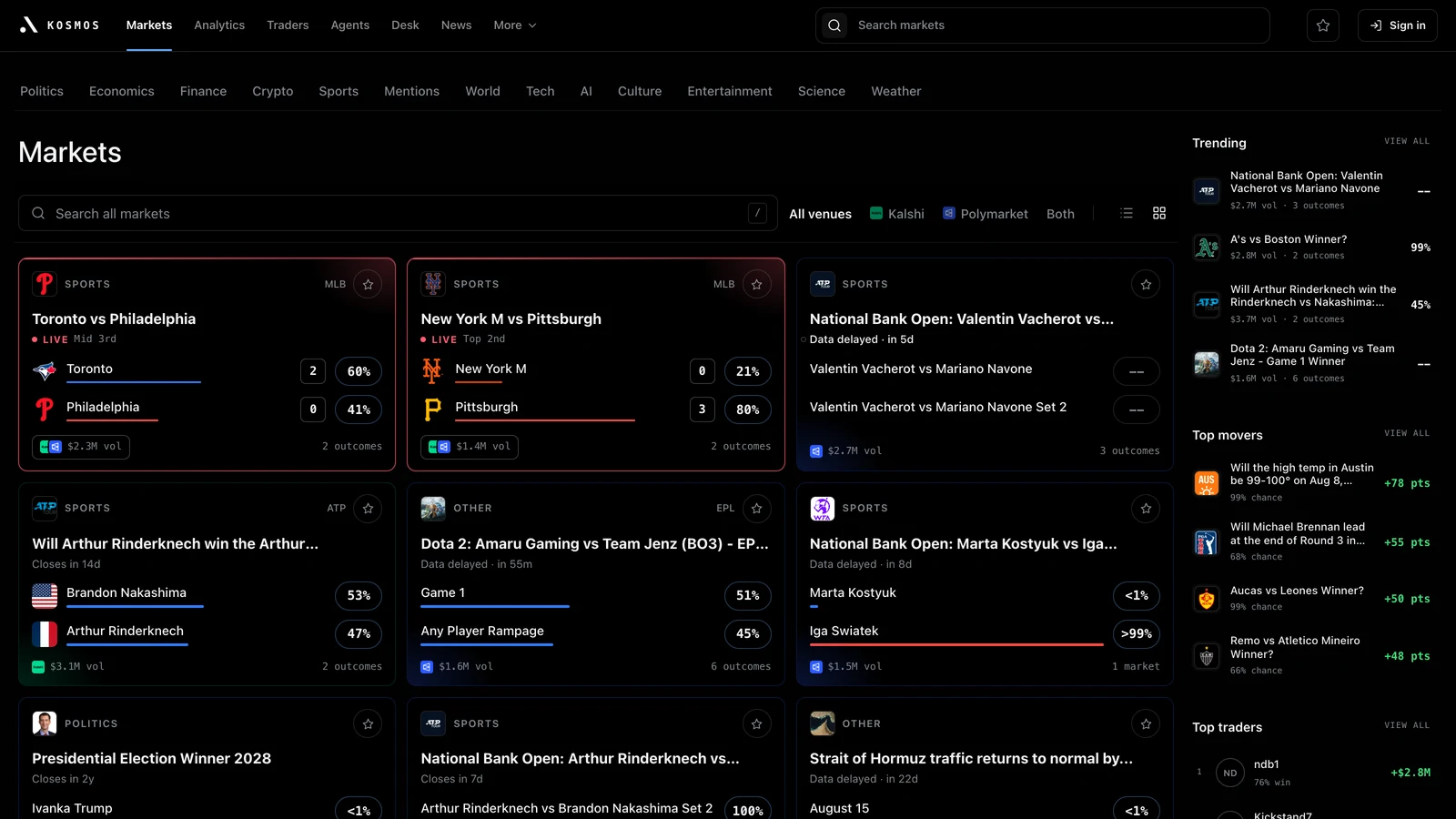
Tickets cost somewhere between 1¢ and 99¢. A ticket that costs 63¢ means the market thinks there is a 63% chance of rain. Cheap ticket, unlikely thing. Expensive ticket, likely thing.
The price and the percentage are the same number. 63¢ is 63%. If you remember one thing, remember that.
- Ticket costs
- 63¢
- what you pay today
- Market thinks
- 63%
- chance of rain
- Ticket pays
- $1.00
- if it rains
3. How you make or lose money
You paid 63¢. Friday comes and one of two things happens.
- It rains. Your ticket pays $1. You paid 63¢, so you keep 37¢ of profit.
- It does not rain. Your ticket pays nothing. You are out the 63¢ you paid.
You do not have to wait for Friday. If the forecast turns and the ticket climbs to 80¢, you can sell it for 80¢ and take the 17¢ without ever finding out whether it rained.
4. Being right is not enough
Look at those numbers again. You risked 63¢ to make 37¢. That means you have to win more than 63 times out of 100 just to break even. Not to profit. To break even.
So a cheap ticket is not automatically a good deal, and an expensive one is not automatically a bad one. The price already contains what everybody else thinks.
You only make money if you know something the price does not.
5. YES and NO are the same trade
Every market has two sides. If YES costs 63¢, then NO costs 37¢, because one of them has to happen.
Buying NO at 37¢ and selling YES at 63¢ are the same position wearing different labels. If you think the crowd is too high on something, you buy the other side. Nothing is borrowed and nothing is shorted.
6. Somebody has to decide who won
This is the part beginners skip, and it is the part that takes their money. Every market comes with a rulebook: which source gets checked, at what exact time, and what happens in the strange cases.
Does a drizzle count as rain? Which weather station? What if the reading is published an hour late? Somebody wrote those answers down before you showed up, and those answers, not your opinion about the weather, decide whether you get paid.
Read the rules before you look at the price.
7. Why the price moves
There is no formula behind the number. The price is whatever the last buyer and the last seller agreed on, not a line a house has set. When news lands, or when somebody wants in badly enough to pay more, it moves. It is people, all the way down.
8. The price on the screen is not the price you get
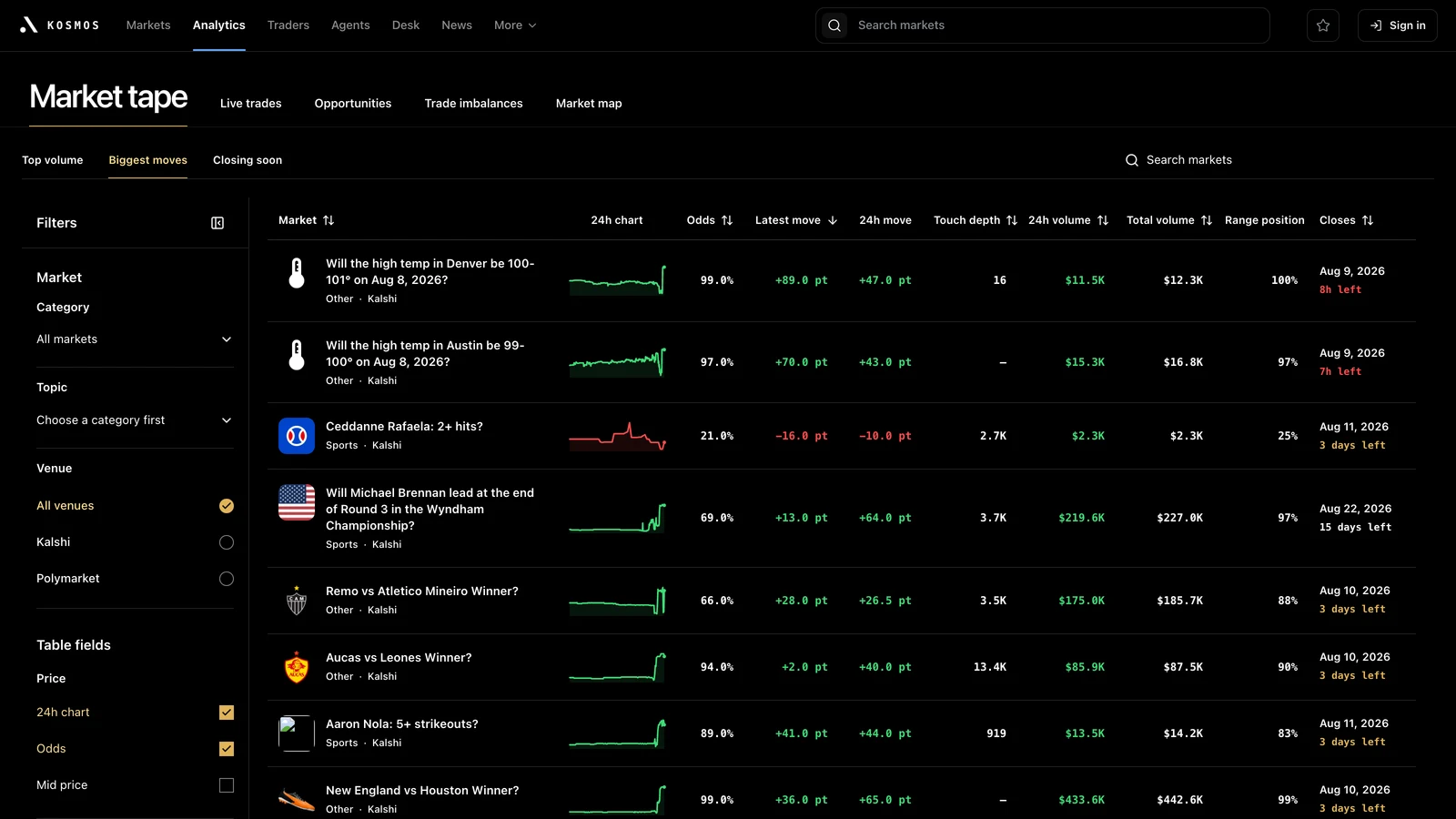
That 63¢ on a screener is the last trade. It might have been one ticket, an hour ago. What you can buy right now sits in the order book, and it has three parts worth knowing.
- The spread. The cheapest price anyone will sell to you at is always a bit above the best price anyone will buy from you at. That gap is a cost, and you pay it the second you enter.
- The depth. How many tickets are on offer at that price. A great price on five tickets is no use if you want five hundred.
- Your real price. Buy more than is available at 63¢ and the rest fills higher. What matters is your average, not the number you saw.
9. What it costs to hold a position
- The spread, paid on the way in and again on the way out.
- Fees, which differ by venue and sometimes by how you traded.
- Your money, stuck. It sits in the position until the market settles. A market that resolves in nine months has your cash for nine months.
10. What an edge is, in plain words
The price says 63%. You think it is 75%. That gap is the entire reason to trade. Agree with the price and there is nothing to win.
Thinking it is 75% is the easy part. Being right about gaps like that, again and again across many markets, is the hard part, and it is the only part that pays.
11. How to find out whether you are any good
- Write your number down before you look at the price. Otherwise you are agreeing with the market and calling it a view.
- Keep score across a lot of markets. Twenty is a story. Two hundred starts to be proof.
- Check yourself by category. Most people are good at one or two subjects and give it all back on the rest. One overall number hides both.
12. The five ways beginners lose money
- Buying lottery tickets. A 3¢ ticket feels cheap and harmless. Long shots are historically overpriced and heavy favourites underpriced, which is the oldest bias in betting markets.
- Trading the headline instead of the market. The story can be completely true and still not move the specific question you bought.
- Skipping the rulebook until it settles against you on a technicality.
- Buying more than you can sell. The widest-looking edges sit in the emptiest markets, and in an empty market the person filling your order usually knows more than you do.
- Making the same bet five times. Five markets that all depend on one story is one position with five receipts.
Part two: the terms
Grouped by where you meet them.
The instrument
- Contract (or share). The unit you buy. Pays $1 or $0.
- YES / NO. The two sides. Buying NO at 37¢ is the same exposure as selling YES at 63¢.
- Event. The real-world thing being asked about.
- Market. One specific question about that event, with its own rules and its own book.
- Strike. The threshold in the question. A rate decision can list several strikes, and they do not move together.
- Expiry. When trading stops.
- Settlement. When the contract pays out, which can be later than expiry.
The book
- Bid. The highest price someone is currently willing to buy at.
- Ask (or offer). The lowest price someone is currently willing to sell at.
- Spread. Ask minus bid.
- Mid. The midpoint of bid and ask. A useful reference, not a price you can trade.
- Depth. Resting size at each price level.
- Limit order. An order at a price you name. It may never fill.
- Market order. An order that takes whatever the book offers. It always fills, at a price you find out afterwards.
- Maker / taker. Whether you added liquidity or removed it. Venues usually charge the two differently.
- Slippage. The difference between the price you saw and the average price you got.
- Liquidity. How much you can trade without moving the price.
Price and probability
- Implied probability. The price, read as a percentage.
- Last price. The most recent trade. History, not an offer.
- Favourite-longshot bias. The tendency for low-probability contracts to trade above their true odds and high-probability ones below.
- Basis. The gap between two things that should be the same, most often the same question on two venues.
- Effective spread. The real cost of crossing, measured at the size you actually want rather than at one contract.
Resolution and risk
- Resolution source. The named authority the contract settles against.
- Resolution criteria. The full text of what counts, when, and what happens in edge cases.
- Oracle. The mechanism that reports the outcome on chain, on venues that work that way.
- Dispute. A challenge to a proposed outcome, with its own window and its own rules.
- Invalid (or void). The market is cancelled and capital returned, usually because the question became unanswerable.
- Basis risk. The risk that the thing you wanted to bet on and the thing the contract settles against are not the same thing.
Performance
- Base rate. How often this kind of thing happens in general, before you know anything specific.
- Calibration. Whether things you call 70% happen about 70% of the time.
- Discrimination. Whether you separate the things that happen from the things that do not. Calibration without it means you are repeating the consensus back to itself.
- Brier score. A standard score for probabilistic forecasts. Lower is better, and it can be decomposed into calibration and discrimination.
- Track record. A scored history with sample sizes attached. Without the sample size it is marketing.
- Edge. A repeatable, measured gap between your probability and the market's.
- Drawdown. How far down you go before you come back, which is the part that decides whether you are still holding.
None of this says what to trade. It says what you are holding, what it costs to hold, and how you would find out whether your read is any good. That last part is the only one that compounds.