
Polymarket vs. Kalshi in 2026: Fees, Liquidity, Odds, and Markets
Matthew Figula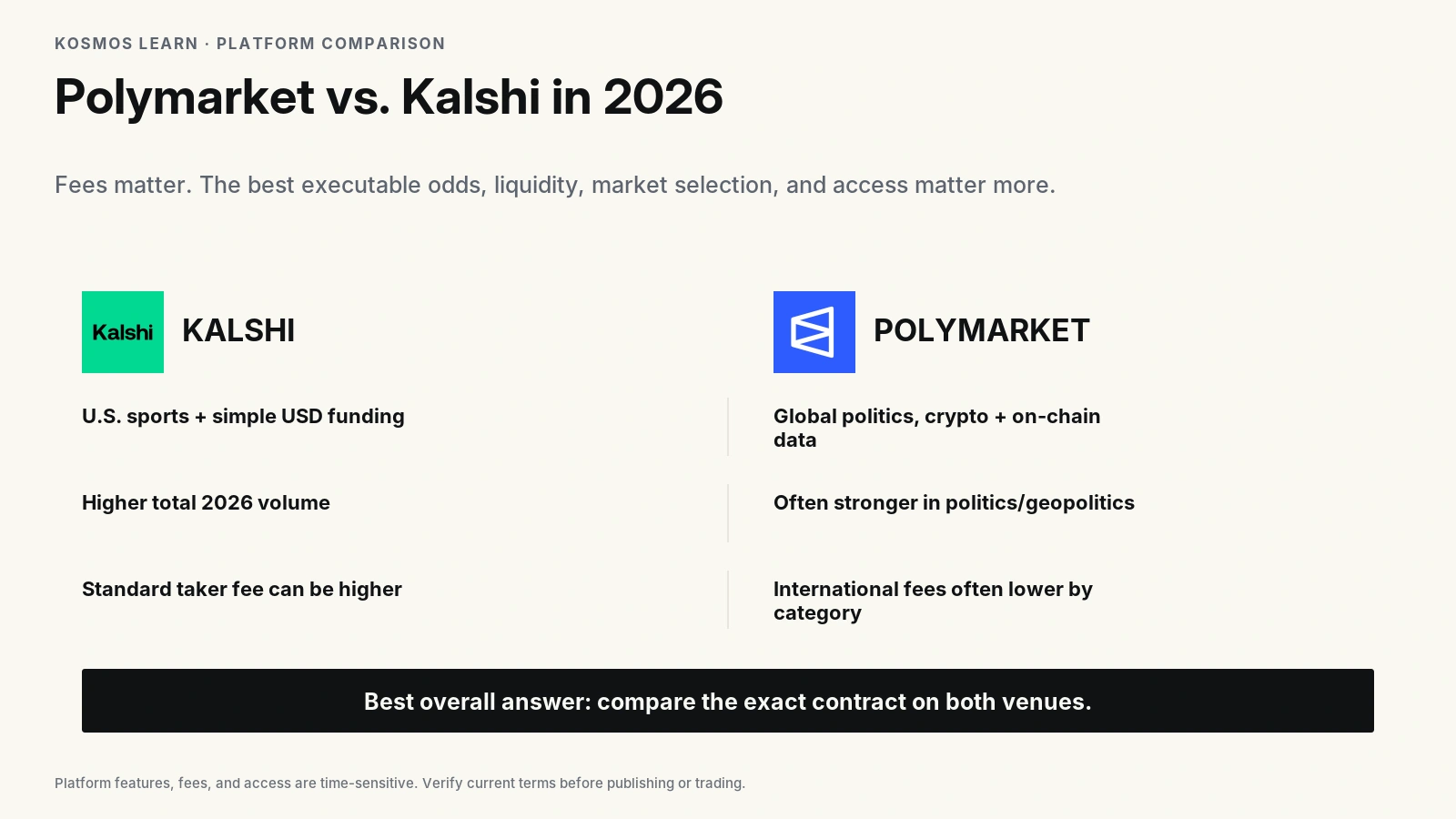
Polymarket and Kalshi are the two names most people hear first when they discover prediction markets. Both let you buy and sell contracts on sports, politics, economics, crypto, and real-world events. Both use order books instead of acting like traditional sportsbooks. Both can show a market price such as 62¢ to represent roughly a 62% implied probability.
But they are not the same product.
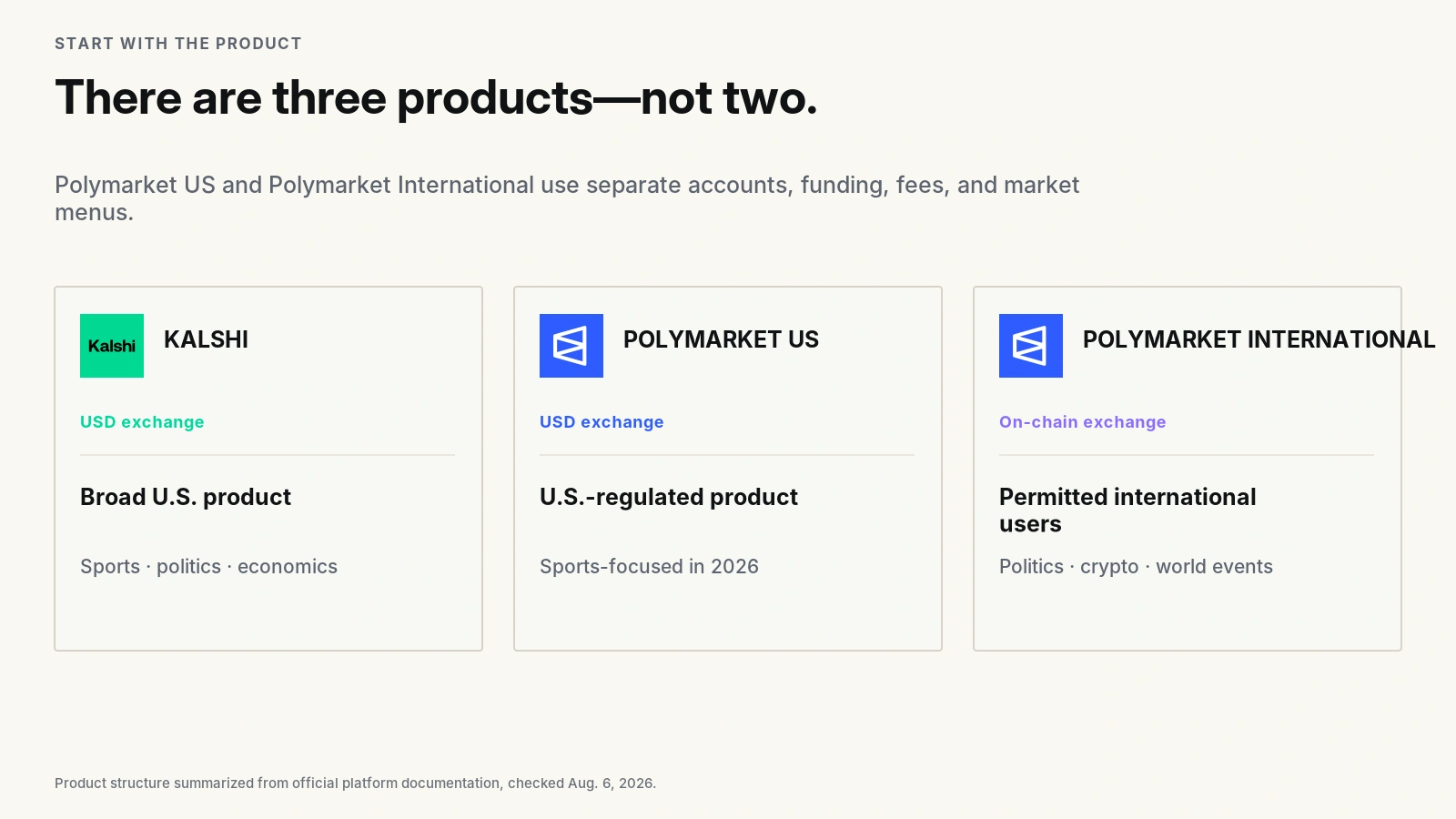
The most important detail is that Polymarket now refers to two separate platforms:
- Polymarket US, a regulated dollar-based exchange for U.S. residents.
- Polymarket International, the crypto-based product on Polygon available in permitted countries.
That means the real comparison in 2026 is not simply Polymarket versus Kalshi. It is:
Kalshi vs. Polymarket US vs. Polymarket International.
Kalshi and Polymarket US both offer dollar-based accounts and several market categories. Polymarket International has separate access rules, wallet mechanics, and fee schedules. A venue-wide ranking cannot tell you which exchange has the better executable price for your order.
The most important lesson is that the platform with lower published fees does not always have the best odds. A two- or three-cent price difference can matter more than the fee difference. Serious traders should compare the executable price, fee, spread, depth, and contract rules on every market.
Polymarket vs. Kalshi: the quick answer
| Question | Best answer in 2026 |
|---|---|
| Which is better for most U.S. users? | Compare Kalshi and Polymarket US if eligible. The relevant differences are available contracts, funding, fees, and executable depth. |
| Which is better for U.S. sports? | Compare the exact game and contract on each eligible venue. Historical sports volume is not a current quote. |
| Which is better for politics and geopolitics? | Compare the available contract and its rules. Polymarket International is one option for eligible users, with fee-free geopolitical markets under the checked schedule. |
| Which is better for crypto markets? | Compare the contract type and settlement source. Polymarket International is on-chain; both U.S. venues also list crypto markets. |
| Which has lower fees? | Polymarket International in many categories. Polymarket US and Kalshi both charge meaningful taker fees. |
| Which has better odds? | Neither one consistently. Compare the exact market, executable ask, fee, spread, and depth. |
| Which has more liquidity overall? | No venue-wide answer establishes liquidity now. Check the spread and depth for the intended order size. |
| Are both legal in the United States? | Kalshi and Polymarket US operate CFTC-designated exchanges. Eligibility is still account-, location-, and contract-specific. Polymarket International blocks U.S. trading. |
| Do you need crypto? | Not for Kalshi or Polymarket US. Polymarket International is an on-chain, crypto-based product. |
| What should serious traders use? | Both available venues, plus Kosmos to compare them. The best all-in price changes continuously. |
First, understand the two versions of Polymarket
A lot of Polymarket-versus-Kalshi articles become confusing because they use “Polymarket” to describe two different exchanges.
Polymarket US
Polymarket US is the company’s regulated product for U.S. residents. It trades in U.S. dollars and operates through a Commodity Futures Trading Commission-designated contract market. The U.S. platform has a separate account, fee schedule, funding system, and market catalog from Polymarket International.
On October 13, 2026, Polymarket US’s official overview listed sports, politics, crypto, economics, weather, technology, and culture. Check the live catalog for the specific event and contract you want.
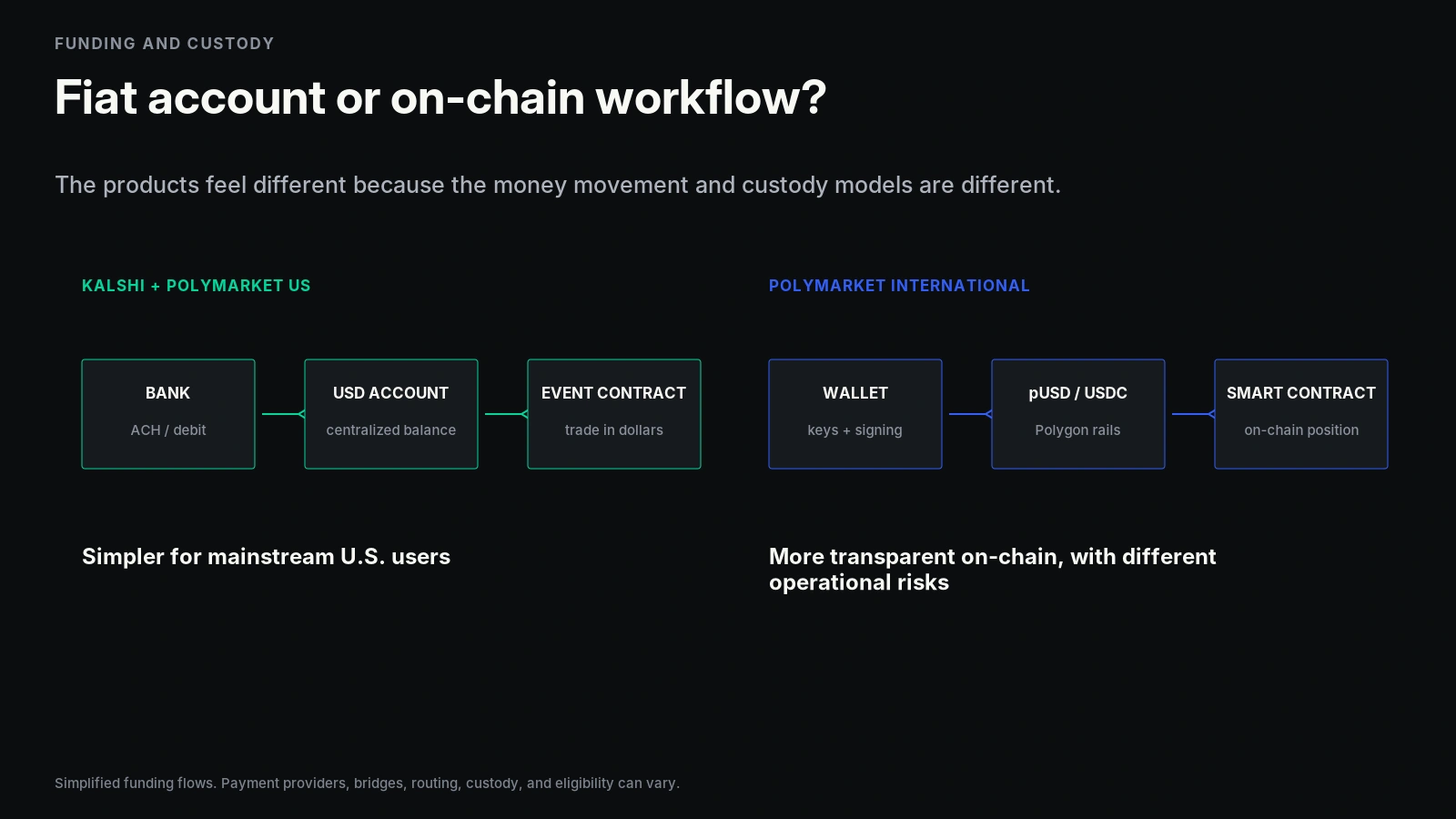
Polymarket US supports bank and card funding alongside other payment methods described below. A crypto wallet is optional.
Polymarket International
Polymarket International is the original crypto-native exchange on Polymarket.com. It runs on Polygon and uses on-chain contracts. Its collateral token is pUSD, which Polymarket describes as backed by USDC through smart contracts.
Some users call this product Polymarket Global. Polymarket’s official pages generally call it Polymarket International or simply Polymarket.com. Those names refer to the non-U.S. on-chain product in this article.
Polymarket International is usually what people mean when they talk about:
- Large political markets
- Global elections
- Geopolitical events
- Crypto milestones
- Publicly visible wallet positions
- On-chain prediction-market activity
The United States is listed as a restricted country for Polymarket International. Eligible U.S. residents can apply to the separate Polymarket US product.
Polymarket vs. Kalshi comparison table
| Feature | Kalshi | Polymarket US | Polymarket International |
|---|---|---|---|
| Primary audience | U.S. users and eligible international users | U.S. residents | Users in permitted international locations |
| Regulatory structure | CFTC-designated contract market since 2020 | CFTC-designated contract market since 2025 | Separate crypto-based international product |
| Trading currency | U.S. dollars | U.S. dollars | pUSD collateral backed by USDC |
| Main strengths | Dollar-based account, multiple categories and funding methods | Dollar-based account, multiple categories and funding methods | On-chain activity and category-based fees |
| Standard taker fee at 50¢ | $1.75 per 100 contracts | About $1.74 per 100 contracts | $0 to $1.75 per 100 shares depending on category |
| Maker treatment | Resting orders often avoid the standard taker fee; some series have maker fees | Maker rebates change to volume tiers on October 19, 2026; check the schedule | Makers are not charged and may receive category-based rebates |
| Liquidity check | Live bid, ask, and depth at your size | Live bid, ask, and depth at your size | Live bid, ask, and depth at your size |
| Funding options | ACH, debit, wire, PayPal, Venmo, Cash App deposits, crypto | ACH, debit, Apple Pay, PayPal, Venmo, USDC where available, wire | Crypto and supported on-ramps |
| Sports | Available; compare each order book | Available; compare each order book | Available; compare each order book |
| Politics | Available; contract eligibility varies | Listed in the official catalog | Available to eligible users |
| Crypto | Available | Listed in the official catalog | Available; settlement source varies by contract |
| Transparency | Conventional centralized account and exchange records | Conventional regulated U.S. exchange | Trades, wallets, and positions are visible on-chain |
| Resolution | Exchange applies written rules and named sources | Regulated exchange applies written rules | UMA for prediction markets; Chainlink TWAP for up-down markets |
| Account fit | Eligible users seeking a dollar-based exchange | Eligible U.S. residents seeking a dollar-based exchange | Eligible users comfortable with on-chain trading |
Fees, funding methods, catalog descriptions, and settlement mechanics were rechecked against official sources on October 13, 2026. Historical volume observations retain their stated periods; they are not live liquidity rankings.
Which has lower fees: Polymarket or Kalshi?
The simple answer is:
Polymarket International has lower fees in many categories. Polymarket US and Kalshi are both fairly expensive for traders who immediately take liquidity.
Neither exchange charges sportsbook-style “vig.” They are exchanges that match buyers and sellers. Your true trading cost can include:
- The platform’s explicit fee
- The bid-ask spread
- Slippage on a larger order
- Deposit or withdrawal costs
- The cost of selling the position later
The explicit fee is only one part of the trade.
Kalshi fees in 2026
Kalshi’s standard taker-fee formula is:
Fee = round up(multiplier × 0.07 × contracts × price × (1 − price))
The fee is highest around a 50¢ contract and gets smaller as the price approaches 0¢ or $1.
The published general-fee table gives these approximate fees for 100 contracts with the default taker multiplier of 1. Exact fill and account rounding can differ:
| Contract price | Position cost | Approximate Kalshi taker fee |
|---|---|---|
| 10¢ | $10 | $0.63 |
| 25¢ | $25 | $1.32 |
| 50¢ | $50 | $1.75 |
| 75¢ | $75 | $1.32 |
| 90¢ | $90 | $0.63 |
At 50¢, the $1.75 fee is 3.5% of the $50 contract cost. Kalshi generally charges the taker fee when an order is matched immediately against an order already resting in the book. An order that rests first may avoid the standard taker fee, although certain market series have separate maker-fee schedules.
Kalshi does not charge a settlement or membership fee. ACH deposits and ACH withdrawals are free, while card and other payment methods can have separate costs.
Polymarket US fees in 2026
Polymarket US’s standard binary taker coefficient changed on October 7, 2026:
Fee = 0.0695 × contracts × price × (1 − price)
At 50¢, 100 contracts incur about $1.74 after cent rounding. Table-tennis contracts use a different coefficient; combos have a separate curve.
That means someone buying 100 contracts at 50¢ spends:
- $50 on the contracts
- About $1.74 in taker fees
- About $51.74 total before spread or slippage
The rounded fee is about 3.48% of the $50 contract cost. If a trader enters and later exits near 50¢ as a taker both times, the two fees can remove a meaningful part of a small edge.
As of October 13, the standard maker rebate is about 31¢ per 100 contracts at 50¢. From October 19 at 1 p.m. ET, maker rebates become volume-tiered, with no rebate in the lowest tier. Taker rebates also change. Check the official schedule before relying on an incentive.
Maker economics depend on applicable rebates, whether the order fills, and how the market moves after the fill.
Polymarket International fees in 2026
The old claim that “Polymarket has no fees” is no longer accurate for most categories.
Polymarket International now charges taker fees based on market category:
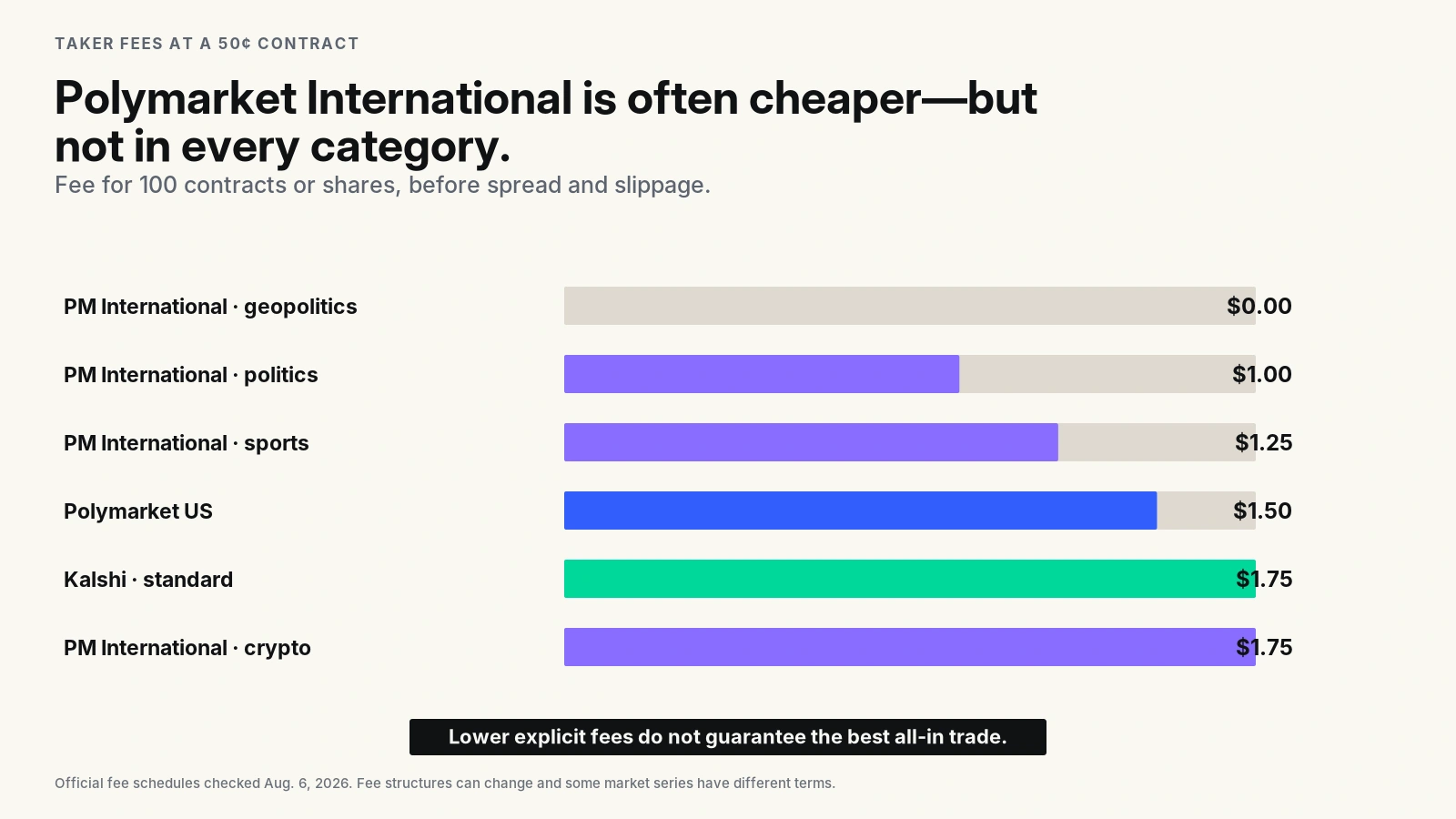
| Polymarket International category | Taker fee on 100 shares at 50¢ |
|---|---|
| Geopolitics and world events | $0.00 |
| Politics | $1.00 |
| Finance | $1.00 |
| Technology | $1.00 |
| Mentions | $1.00 |
| Sports | $1.25 |
| Economics | $1.25 |
| Culture | $1.25 |
| Weather | $1.25 |
| General markets | $1.25 |
| Crypto | $1.75 |
Makers are not charged a trading fee. The taker fees fund maker rebates intended to improve depth and tighten spreads.
Polymarket says it does not charge its own fee for depositing or withdrawing USDC, although an exchange, card provider, bridge, or other intermediary may charge separately.
Fee verdict
The listed Polymarket International rates for politics, finance, sports, technology, and geopolitics are below Kalshi’s default taker curve. Market-specific exceptions and rebates can change that comparison.
But Polymarket International is not always cheaper. Its crypto fee reaches the same maximum as Kalshi’s standard fee. The checked Polymarket US standard binary fee is slightly below Kalshi’s default schedule, but special series, combos, and rebates can change that comparison.
Most importantly, a lower fee does not guarantee a better trade.
Which has better odds: Polymarket or Kalshi?
Neither platform consistently has better odds.
Kalshi, Polymarket US, and Polymarket International all use order books. Traders and market makers submit bids and asks. The platform matches orders. Prices change as information, demand, and available liquidity change.
This creates real price differences between venues.
A market could show:
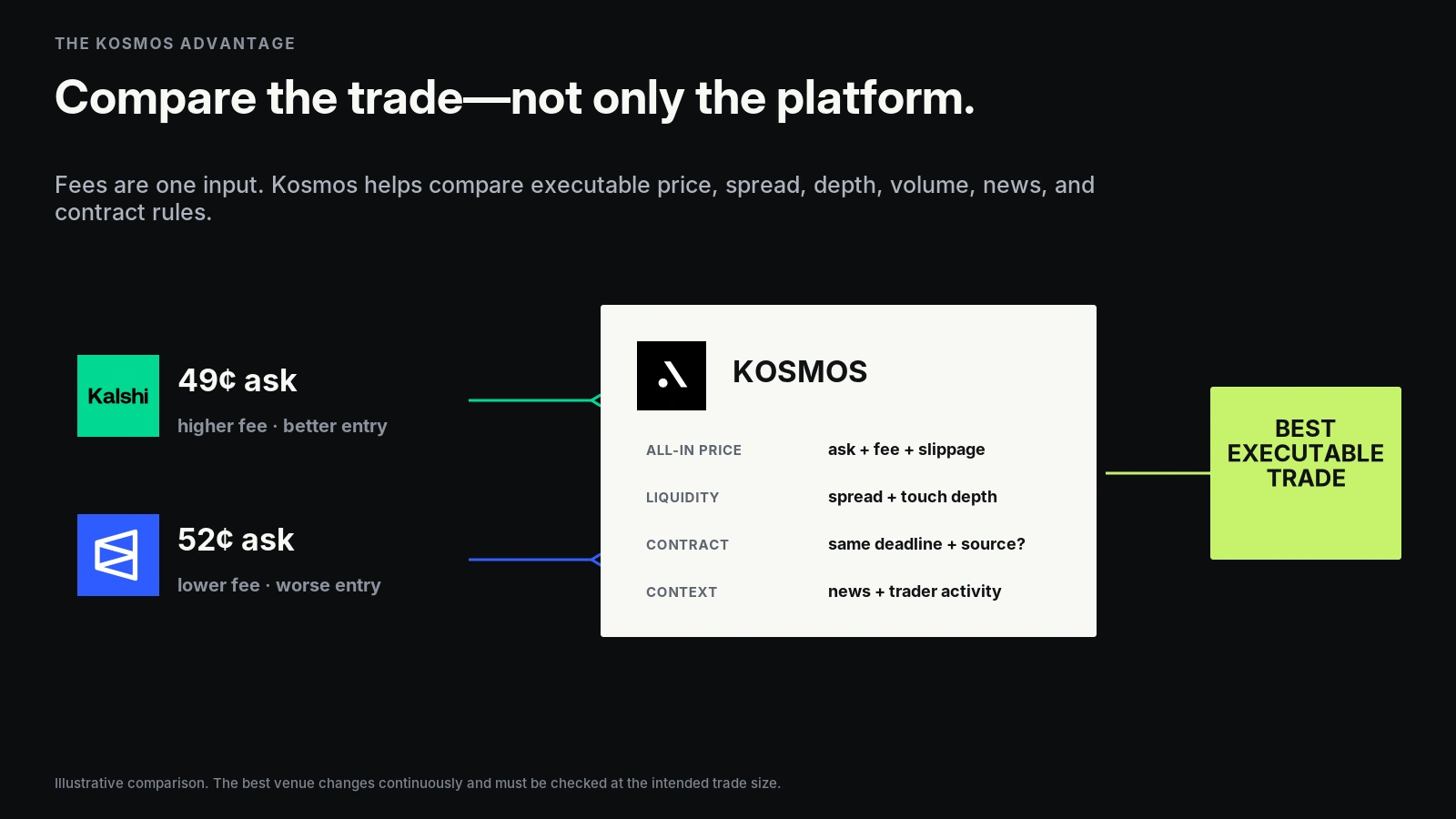
- Kalshi YES at 49¢
- Polymarket YES at 51¢
Even if Polymarket charges a lower fee, Kalshi may still offer a much cheaper entry.
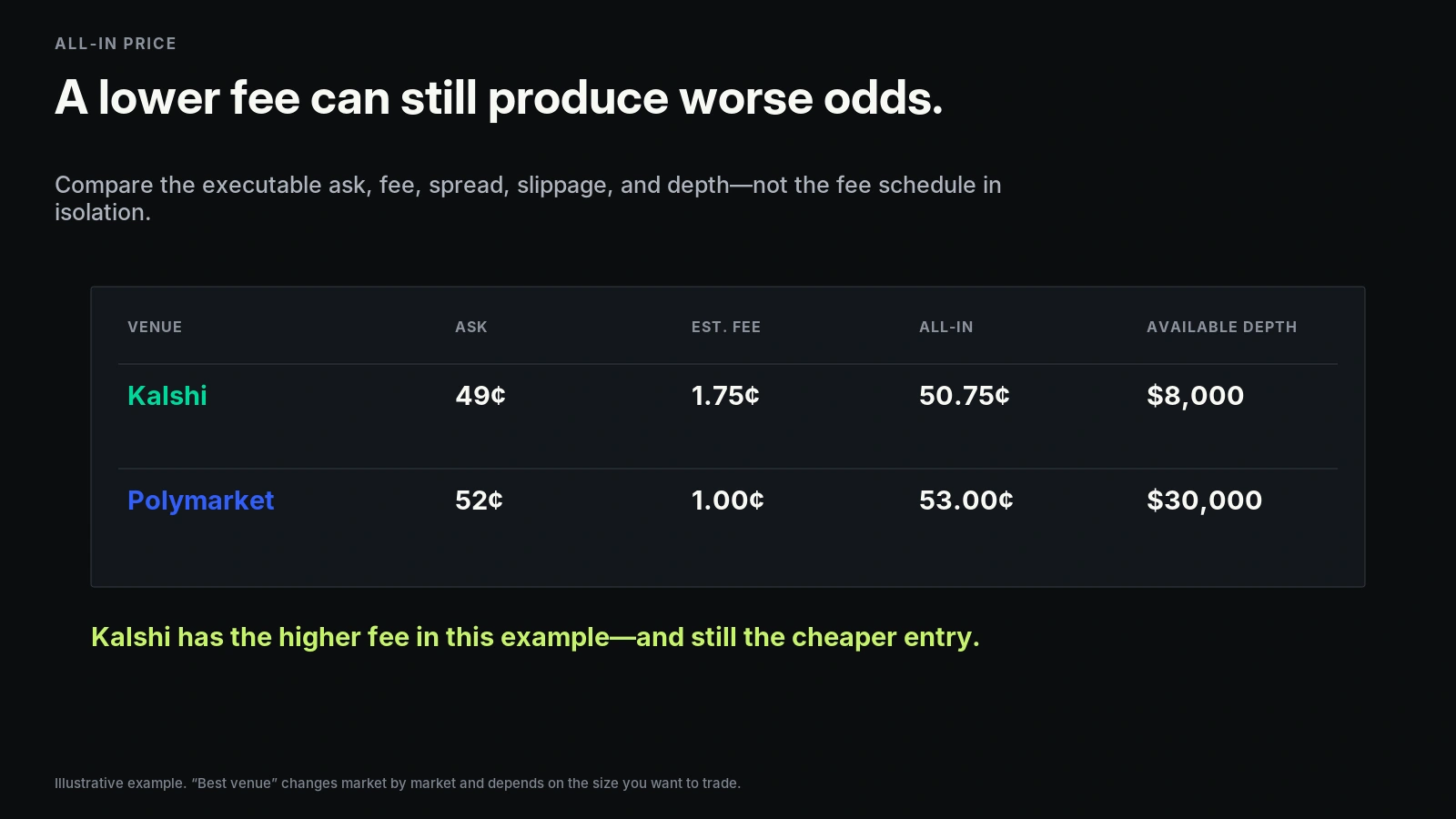
Worked example: lower fee, worse odds
Assume you want to buy 100 YES contracts in a political market.
| Cost | Kalshi | Polymarket International |
|---|---|---|
| Best executable ask | 49¢ | 51¢ |
| Contract cost | $49.00 | $51.00 |
| Approximate taker fee | $1.75 | $1.00 |
| All-in entry cost | $50.75 | $52.00 |
Polymarket’s fee is 75¢ lower.
But its contract price is $2 higher across 100 shares. After fees, Kalshi is still $1.25 cheaper.
The fee comparison alone would have produced the wrong decision.
The displayed percentage may not be the price you can buy
Another common mistake is comparing the large probability shown on each market page.
The displayed number may be:
- A midpoint between the bid and ask
- The most recent trade
- A delayed quote
- A price available for only a small amount
Suppose a platform displays 52%, but the order book is:
- Best bid: 49¢
- Best ask: 55¢
A buyer cannot necessarily buy at 52¢. An immediate buyer pays the 55¢ ask.
For a meaningful comparison, use:
All-in entry cost = executable ask + trading fee + expected slippage
For a seller, compare the executable bid after costs.
Depth matters when you trade more size
The platform with the best price for 100 contracts may not be best for 10,000 contracts.
Imagine:
- Kalshi offers 100 contracts at 51¢, then the next large block is at 56¢.
- Polymarket offers 8,000 shares between 53¢ and 54¢.
Kalshi wins for a very small order. Polymarket may win for a larger one because its average fill is better.
This is why serious traders compare:
- Best bid and ask
- Spread
- Touch depth
- Depth through the full order size
- Trading fee
- Contract rules
The Kosmos advantage: compare the market, not the brand
Choosing one prediction-market app and using it for every trade is convenient. It is not always the best-value approach.
Kosmos brings Kalshi and Polymarket markets into one workspace. Its Markets page supports Kalshi, Polymarket, and combined venue views. Its Market Tape can show fields such as:
- Price and midpoint
- Latest movement
- Spread
- Touch depth
- 24-hour volume
- Total volume
- High-low range
- Trend strength
- Realized variation
- Closing time
Kosmos also connects current news and market context to relevant contracts.
That lets you ask a better question than “Which platform has lower fees?”
You can ask:
Which venue gives me the lowest all-in price for the exact contract and size I want right now?
This is where the largest practical value often comes from. A one-cent fee difference matters. A four-cent price difference usually matters more.
Compare live Kalshi and Polymarket markets in Kosmos →
For more detail on why the executable order-book price matters, read How Prediction Market Order Books Work. To understand how price differences translate into value, read Positive Expected Value in Prediction Markets. For the products that run these comparisons for you, read Best Polymarket Analytics Tools.
Which has more liquidity: Polymarket or Kalshi?
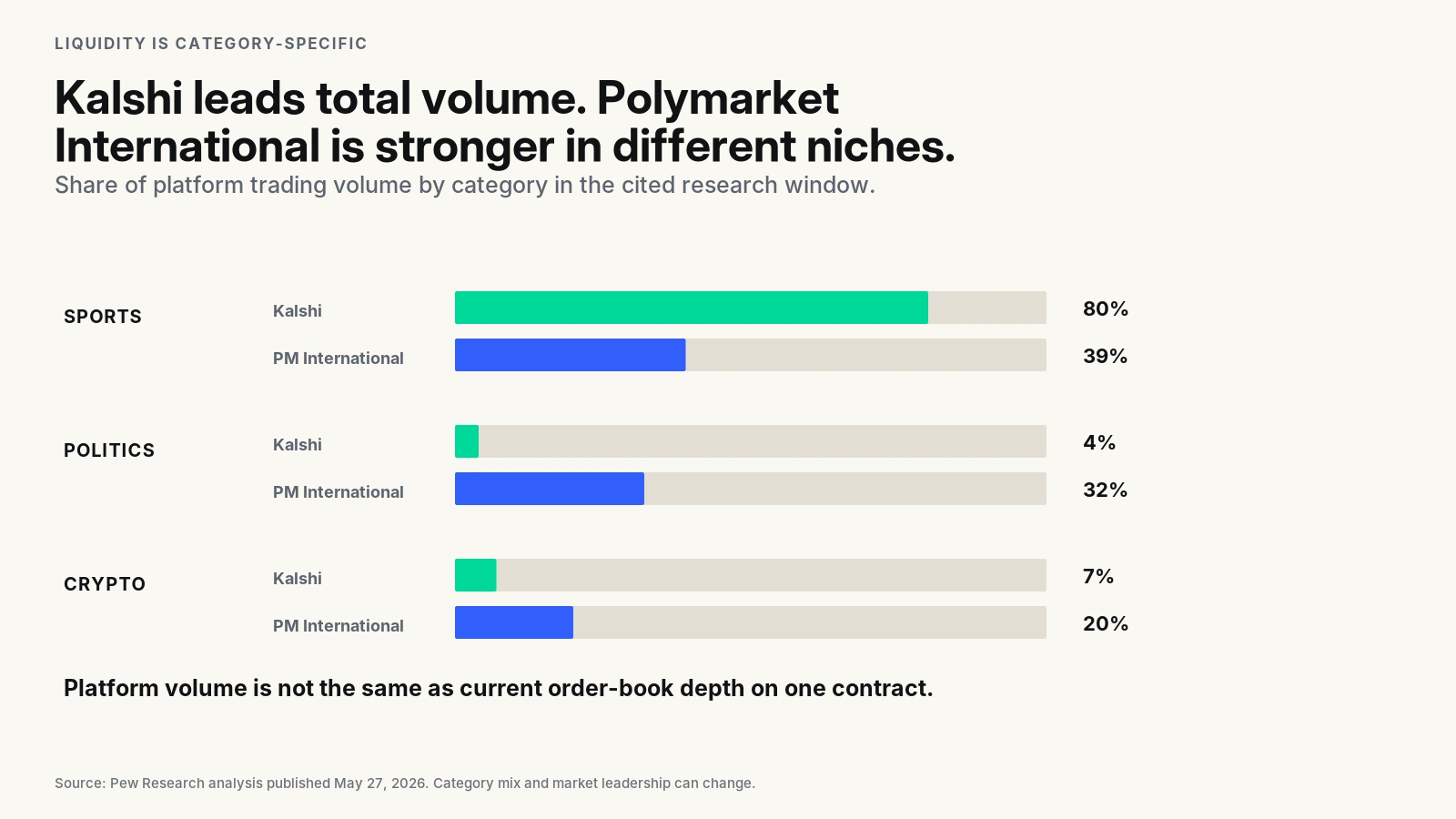
Historical volume provides scale, not an executable quote. Pew Research Center’s September 23, 2026 analysis reported about $53.0 billion in combined July notional taker volume: approximately $40.1 billion on Kalshi and $12.9 billion across Polymarket International and Polymarket US combined.
This counts contracts at their $1 notional value, not the cash paid for them. Pew ended its category analysis in July because of changes in category-data availability. These are dated observations, not current market-share or liquidity measurements. Pew’s dataset and methodology
But total platform volume does not tell you which venue is most liquid for one specific event.
Volume and liquidity are not the same thing
Volume tells you how much has already traded.
Liquidity tells you how easily you can trade now without moving the price too much.
A market can have $10 million in historical volume and still have a weak order book at this moment. Another market can have less total volume but more size available near the current price.
Current liquidity depends on:
- Bid-ask spread
- Contracts available at the best price
- Depth beyond the first level
- How quickly new orders appear
- Market-maker participation
- Your intended order size
Historical sports activity on Kalshi
Pew Research Center analyzed category data from July 2024 through April 2026 and found that sports represented approximately 80% of Kalshi’s total volume.
That historical mix makes Kalshi worth checking for:
- NFL
- NBA
- MLB
- College sports
- Large U.S. sporting events
- Mainstream sports contracts with heavy retail activity
Pew’s later July analysis found a large sports-volume increase around the World Cup on both platforms. That does not establish which venue offers the best fill today.
Historical politics and crypto activity on Polymarket International
The same Pew analysis found a very different mix on Polymarket International:
- Sports: approximately 39% of volume
- Politics: approximately 32%
- Crypto: approximately 20%
On Kalshi, politics represented about 4% and crypto about 7% over the same period.
Those historical shares provide context for researching:
- Elections
- Political nominations
- Geopolitical events
- International news
- Crypto prices and milestones
- Global events that receive less attention on U.S.-regulated exchanges
Liquidity verdict
- Historical July volume: Kalshi led in the cited Pew dataset
- Major U.S. sports: Compare current depth on eligible venues
- Politics and global events: Check availability and resolution terms
- Crypto: Check the exact contract and settlement source
- One exact market: Compare both order books
The historical category mix is useful context. The order book in front of you is what determines the trade.
Which platform has more markets?
The answer depends on whether you are comparing Kalshi with Polymarket US or Polymarket International.
Kalshi market selection
Kalshi currently offers a broad U.S.-facing menu across categories such as:
- Sports
- Elections and politics
- Economics
- Finance
- Crypto
- Weather and climate
- Technology and science
- Culture and entertainment
- Public mentions
- Commodities
Its biggest strength is that one regulated, dollar-based account provides access to many types of markets.
Polymarket US market selection
Polymarket US lists sports alongside politics, crypto, economics, weather, technology, and culture.
Its sports categories include:
- NFL
- NBA
- NHL
- MLB
- MLS
- College basketball
- Tennis
- Golf
The live catalog changes. A broad category label does not establish that a particular event, line, or settlement rule is offered.
Eligible U.S. users can compare it with Kalshi for each available event, including price, depth, fees, and maker economics.
Polymarket International market selection
Polymarket International lists global and internet-driven markets, subject to its access rules.
Its strengths include:
- U.S. and international politics
- Elections outside the United States
- Geopolitical conflicts
- Crypto
- Technology launches
- Corporate events
- Entertainment
- Internet culture
- Public statements
- Unusual news-driven questions
The international platform’s ability to list global, niche, and controversial events is one reason it remains important even as regulated U.S. prediction markets grow.
Market-selection verdict
| Category | Venues to compare if eligible |
|---|---|
| Major U.S. sports | Kalshi and Polymarket US |
| Multiple U.S. market categories | Kalshi and Polymarket US |
| U.S. sports price comparison | Kalshi and Polymarket US |
| Politics | Polymarket International |
| Geopolitics | Polymarket International |
| Crypto | Polymarket International |
| Global or unusual events | Polymarket International |
| Traditional U.S. banking and multiple categories | Kalshi and Polymarket US |
Funding and withdrawals: dollars versus crypto
The funding experience may matter more than a small fee difference for a new user.
Kalshi funding
Kalshi’s U.S. funding options include the following; availability varies by account and location:
- ACH bank transfer
- Debit card, including Apple Pay and Google Pay
- PayPal
- Venmo
- Cash App for deposits
- Crypto
- Wire transfer
Kalshi trades in dollars. International accounts have different funding options, and settlement holds can delay withdrawals; check the method offered in your account.
Polymarket US funding
Polymarket US lists ACH, debit card, Apple Pay, PayPal, Venmo, wire transfers, and USDC where available. USDC availability is device- and location-dependent. Trading remains dollar-based.
Check the account’s available methods, fees, limits, and clearance time before transferring funds. Buying power does not necessarily mean a deposit is available to withdraw.
Polymarket International funding
Polymarket International is built around blockchain infrastructure.
Its current system uses:
- Polygon
- pUSD collateral
- One-to-one USDC backing
- Smart-contract settlement
- Publicly visible positions and transactions
For someone who already uses crypto, that can be efficient and transparent.
For someone new to crypto, it adds extra concepts and risks:
- Wallet security
- Stablecoins
- Network selection
- On-ramps and off-ramps
- Smart-contract approvals
- Bridge or routing costs
- Lost keys or compromised wallets
Funding verdict
- Dollar-based accounts: Kalshi and Polymarket US
- Simple U.S. alternative: Polymarket US
- Best for crypto-native users: Polymarket International
- Most publicly transparent transaction history: Polymarket International
Are Kalshi and Polymarket legal in the United States?
This requires a careful answer.
Kalshi
Kalshi has been a CFTC-designated contract market since November 2020. It operates as a federally regulated derivatives exchange rather than as a state-licensed sportsbook.
Polymarket US
QCX, doing business as Polymarket US, became a CFTC-designated contract market in July 2025. Polymarket US is the regulated product intended for U.S. residents.
Polymarket International
Polymarket International is a separate product. The United States appears on its blocked-country list, and Polymarket explicitly says that using a VPN or similar tool to bypass geographic restrictions violates its terms.
Some reporting and research have noted that U.S. users have accessed Polymarket International through VPNs. That reported behavior does not make it allowed. Polymarket explicitly prohibits using VPNs or similar tools to bypass its geographic controls, and doing so can create account, access, withdrawal, and compliance problems.
U.S. users should use Polymarket US rather than attempting to bypass the international platform’s restrictions.
This article does not provide instructions for avoiding geolocation controls.
Designation and eligibility are separate checks
The CFTC identifies these operators as designated contract markets. A designation describes the exchange; it does not establish whether a particular person may trade a particular contract from their location.
This guide is not a state-by-state legal or litigation-status survey. Use current venue eligibility terms and the rules for the exact contract.
The practical answer is:
- Kalshi and Polymarket US operate under federal CFTC designations.
- Access to particular products can change.
- Identity verification, geographic rules, and contract-specific participant restrictions still apply.
- Polymarket International is not the U.S. product and blocks U.S. trading.
Always check the platform’s current eligibility and market-availability rules before depositing.
Which platform is more trustworthy?
Calling one platform “safe” and the other “unsafe” is too simple. They use different structures.
Why Kalshi feels more conventional
Kalshi has the longer history as a CFTC-designated exchange. It uses a conventional dollar account, offers familiar bank funding, and keeps trading activity inside a centralized regulated system.
That makes it easier for many U.S. users to understand.
Kalshi is usually the less complicated choice for someone who wants:
- Traditional identity verification
- U.S. dollar balances
- Bank deposits and withdrawals
- Centralized customer support
- A platform built around U.S. regulation from the beginning
Why Polymarket International feels more transparent
Polymarket International records trades and positions on a public blockchain. Anyone can inspect wallet activity, position sizes, entry timing, and settlement transactions.
That is a real form of transparency. It is one reason whale tracking and wallet analysis are so popular around Polymarket.
But on-chain transparency does not remove risk. It changes the risk.
A user still needs to consider:
- Wallet security
- Smart-contract risk
- Stablecoin risk
- Oracle and dispute risk
- Geographic restrictions
- Anonymous or pseudonymous counterparties
Trust verdict
- More conventional for U.S. users: Kalshi
- Publicly verifiable on-chain activity: Polymarket International
- Regulated Polymarket product for the U.S.: Polymarket US
- Simplest choice for someone unfamiliar with crypto: Kalshi
How market resolution differs
A market’s price is only useful if you understand what makes the contract settle at $1.
Kalshi resolution
Each Kalshi market includes written rules, a deadline, and a named verification source. After trading ends, the exchange applies those rules and determines the outcome.
This is a centralized process.
The benefit is that one regulated exchange is responsible for making the decision. The risk is that traders must rely on its interpretation when the wording or real-world outcome is unclear.
Polymarket International resolution
Polymarket International uses UMA for prediction-market resolution and Chainlink TWAP for up-down markets. The proposal process below describes UMA markets; check the source specified by the exact contract.
In simplified form:
- An outcome is proposed with a bond.
- A challenge period opens.
- The proposal can be disputed.
- A disputed outcome moves through UMA’s resolution process.
- Ordinary winning shares redeem for $1 after finalization; exceptional 50/50 resolution can pay 50¢ per token.
This process is visible and challengeable, but an ambiguous market can take longer to settle.
Polymarket US resolution
Polymarket US is a separate regulated exchange. It does not use the international platform’s crypto-wallet and UMA process in the same way. Polymarket Clearing processes settlement under the contract’s written rules. Some contracts include alternative payouts rather than the ordinary $1/$0 result.
Resolution verdict
Neither system is automatically better for every event.
The important rule is:
Never treat two contracts as equivalent until you have compared their complete resolution rules.
A five-cent difference is not an arbitrage if one contract uses a different deadline, source, threshold, or definition.
Is Kalshi better than Polymarket?
Kalshi and Polymarket US both merit comparison for eligible U.S. users. The better venue depends on the contract and order.
Kalshi offers:
- Multiple categories of event contracts
- Sports markets with publicly quoted order books
- A dollar-based account
- Several funding options, subject to eligibility
- A longer CFTC operating history
- No need to interact with crypto
Those features do not establish a better fill on every trade.
Eligible users can also evaluate Polymarket International for:
- Politics
- Geopolitics
- Crypto
- Global events
- On-chain transparency
- Lower fees in many categories
- Fast-moving or unusual markets
Polymarket US is useful when:
- Its price is better than Kalshi’s
- Its order book has more depth
- A trader wants to provide liquidity and earn maker rebates
- An eligible U.S. user wants another venue for event comparison
Who should use each platform?
| Type of user | Best starting point | Why |
|---|---|---|
| New U.S. prediction-market user | Compare Kalshi and Polymarket US | Check eligibility, funding, contract availability, and all-in cost |
| U.S. sports trader | Compare both U.S. venues | Check the current order book for the exact game and line |
| U.S. trader looking for the best odds | Both Kalshi and Polymarket US | Prices and depth can differ on the same event |
| International politics trader | Polymarket International | Political and global-event contracts for eligible users |
| Crypto trader | Polymarket International | On-chain structure and crypto contracts |
| Geopolitical trader | Polymarket International | Broad market coverage and zero taker fee in the category |
| Market maker | Compare all eligible venues | Fees, rebates, spreads, and queue position differ |
| User who dislikes crypto | Kalshi | Familiar USD account and banking rails |
| User who values public wallet data | Polymarket International | On-chain trades and positions are visible |
| Serious value-focused trader | Use Kosmos and compare both | The best all-in price changes market by market |
Final verdict: Polymarket or Kalshi?
Choose Kalshi when:
- You are eligible and prefer its available markets and funding options
- You mainly trade major U.S. sports
- You want conventional bank and payment options
- You want several market categories in one regulated account
- You do not want to handle wallets or stablecoins
- Its all-in order-book price is better
Choose Polymarket International when:
- You are legally eligible to use it
- You already understand crypto and wallets
- You trade politics, geopolitics, crypto, or global news
- You value public on-chain positions and activity
- You want lower category fees
- Its all-in order-book price is better
Choose Polymarket US when:
- You meet the U.S. product’s eligibility requirements
- It offers a better all-in price than the other eligible venues
- It has more depth for your intended order
- You plan to provide liquidity
- You qualify for taker-volume rebates
- You want a second regulated U.S. venue
The most useful answer
For most U.S. beginners:
Compare Kalshi and Polymarket US by eligibility, funding, and the contracts you want.
For eligible international and crypto-native traders:
Consider Polymarket International’s available contracts, fees, and on-chain mechanics.
For anyone trying to get the best expected value:
Do not choose one platform forever. Compare both markets before every trade.
Fees matter. The executable price usually matters more. Liquidity determines whether the price is available at your size. Contract rules determine whether the two markets are even equivalent.
Kosmos brings those comparisons into one place so traders can evaluate price, spread, depth, volume, movement, news, and contract context before entering.
Open the live market comparison in Kosmos →
Sources and methodology
Fee schedules, funding, catalog descriptions, access documentation, and settlement mechanics were rechecked on October 13, 2026. Volume observations retain their source periods. This was not a new authenticated execution test or a state-by-state legal review.
- Kalshi fee schedule
- Kalshi transfer methods
- Kalshi CFTC designation
- Polymarket US fee schedule
- What is Polymarket US?
- Polymarket US product changelog
- Polymarket US CFTC designation
- Polymarket International fees
- Polymarket International geographic restrictions
- Polymarket International access and anti-circumvention policy
- Polymarket pUSD collateral
- Polymarket resolution sources and process
- Pew Research Center category and volume analysis
- Pew September analysis of July 2026 volume
- Kalshi eligibility
- Polymarket US funding
- Polymarket US trading restrictions
- Polymarket US settlement
- Kosmos Markets
- Kosmos Market Tape
Fees, market availability, eligibility, and product functionality can change. Check the linked official schedule and account terms before placing an order.
Frequently asked questions
Is Kalshi better than Polymarket in 2026?
There is no universal winner. Eligible U.S. users can compare Kalshi and Polymarket US; Polymarket International has separate geographic restrictions and on-chain mechanics. Compare the exact contract, available depth, funding options, and all-in price.
Which has lower fees, Kalshi or Polymarket?
Polymarket International has lower taker fees in many categories. At a 50¢ contract, politics and finance cost $1 per 100 shares, sports costs $1.25, and geopolitics is fee-free. As checked October 13, 2026, Polymarket US charges about $1.74 per 100 contracts at 50¢ under its standard binary schedule, versus $1.75 on Kalshi’s default schedule. Special products and rebates differ. Spread and slippage can be larger than the fee difference.
Which has better odds, Polymarket or Kalshi?
Neither always has better odds. Compare the executable bid or ask, fee, spread, depth, and contract rules. A platform with lower fees can still have a worse all-in price because its contract trades several cents higher.
Which has more liquidity, Kalshi or Polymarket?
Historical volume does not establish current liquidity. Compare the live spread, available size, and depth of each exact contract. The dated volume and category observations below are context, not a current liquidity ranking.
Are Kalshi and Polymarket legal in the United States?
Kalshi and QCX, operating as Polymarket US, are CFTC-designated contract markets. That designation does not establish your eligibility for every contract. Check current venue terms and location restrictions. Polymarket International separately blocks U.S. trading.
Can U.S. residents use Polymarket International with a VPN?
Polymarket explicitly prohibits using VPNs or similar tools to bypass geographic restrictions. Some reporting has described U.S. users doing so, but that does not make it permitted. U.S. residents should use Polymarket US and should not attempt to bypass the international platform’s controls.
Is Polymarket US the same as Polymarket.com?
No. They are separate products. Polymarket US is a dollar-based, CFTC-regulated exchange for U.S. residents. Polymarket International is an on-chain product for users in permitted countries. Accounts, fees, markets, funding, and support are separate.
Is Polymarket Global the same as Polymarket International?
Yes. “Polymarket Global” is an informal name people use for the international product on Polymarket.com. Polymarket’s own documentation generally calls it Polymarket International. It is separate from Polymarket US.
Do I need crypto to use Polymarket?
You do not need crypto for Polymarket US. Polymarket International is a crypto-based product on Polygon and uses pUSD collateral backed by USDC.
Can I use Kalshi and Polymarket at the same time?
Eligible users can maintain accounts on both available platforms. Doing so allows them to compare prices and choose the venue with the better all-in cost and liquidity on each event.
Can you arbitrage between Kalshi and Polymarket?
Sometimes, but a price difference is only true arbitrage when the contracts have identical rules, both orders can fill, fees do not remove the profit, and neither price changes before execution. Different deadlines or resolution sources can turn an apparent arbitrage into two separate directional trades.
Why use Kosmos instead of checking both platforms manually?
Kosmos aggregates Kalshi and Polymarket markets and adds venue-level volume, spread, touch depth, market movement, news, and context in one workspace. This makes it faster to compare the real all-in opportunity rather than switching between several tabs and comparing headline prices manually.