
Prediction Markets vs. Sports Betting: 10 Key Differences
Matthew Figula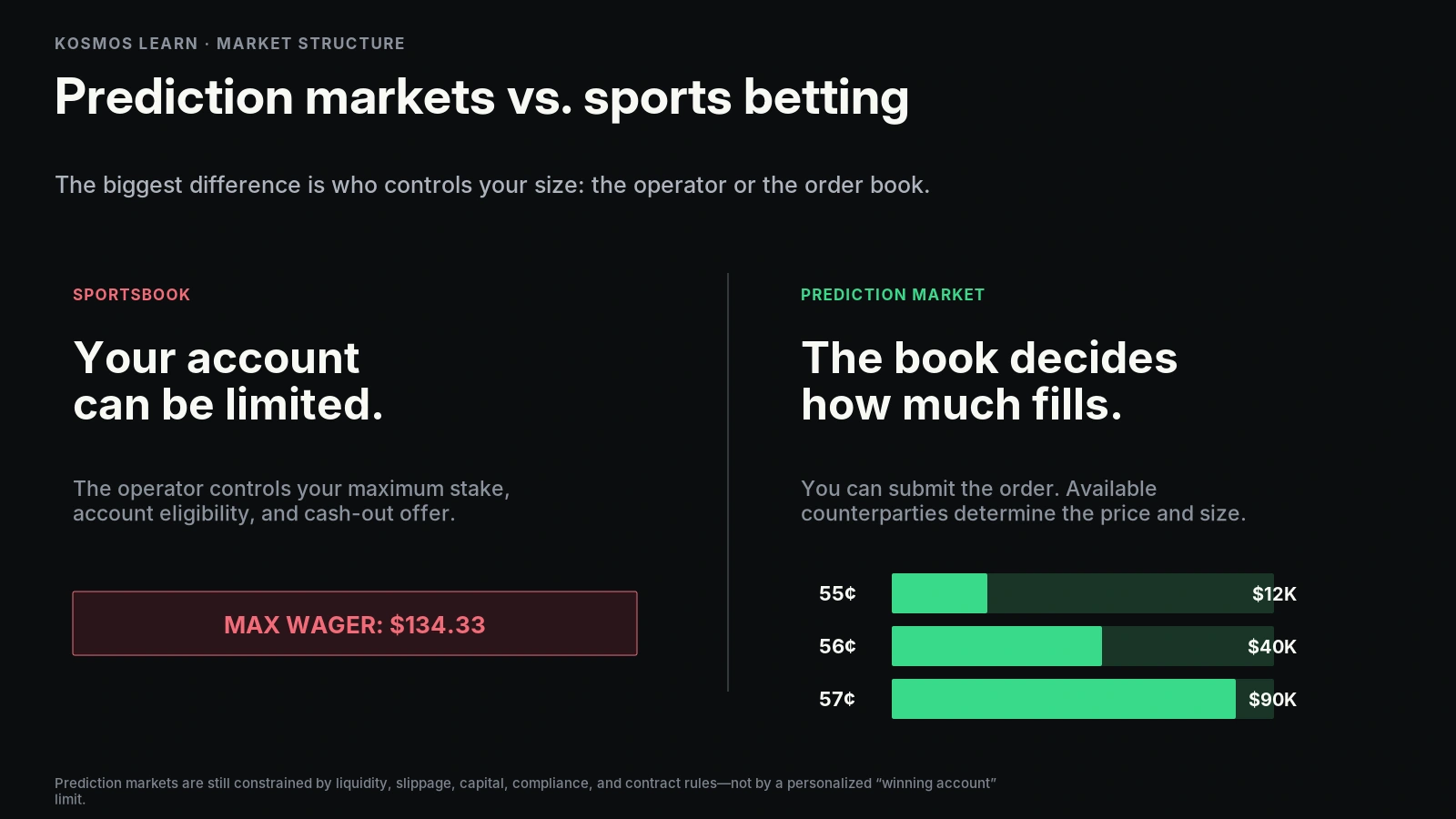
Prediction markets vs. sports betting is a common comparison because both can give you almost the same payout on the same event. The main difference is who controls the trade. A sportsbook sets the odds, accepts your wager, and decides your maximum stake. A prediction market matches buyers and sellers in a public order book, so the main limit is the liquidity available at the price you want.
Sportsbooks are often easier for casual betting. They offer thousands of props, parlays, promotions, and a familiar bet slip. But the sportsbook is also the house. It can lower your maximum stake, accept only part of your wager, reject a bet, or restrict your account.
Prediction markets work more like exchanges. You can post your own price, buy or sell a position, and trade against other participants. Your win rate does not normally change the amount of public liquidity you can access. In a large market, that can give a serious trader much more freedom and much more usable size.
Prediction markets vs. sports betting at a glance
| Feature | Prediction market | Sportsbook |
|---|---|---|
| Who takes the other side? | Another trader or market maker | The sportsbook |
| Who sets the price? | Buyers and sellers through an order book | The sportsbook's trading team and models |
| Common price format | 1¢ to 99¢, read roughly as probability | American, decimal, or fractional odds |
| What limits your size? | Venue and position limits, collateral, available liquidity, and acceptable slippage | The operator's market limit and your account-specific maximum wager |
| Can winning users be personally limited? | Exchange access differs from sportsbook stake-setting, but account and position restrictions still apply | Yes. Sportsbooks can lower stakes, accept only part of a bet, or reject it |
| Main cost | Trading fees, bid-ask spread, and slippage | Vig or margin built into the odds |
| Can you choose your price? | Yes, with a limit order | Usually no; you accept the posted line or wait for it to move |
| Can you exit early? | Yes, by selling at the current public bid; in liquid markets this is usually close to market value | Only when the sportsbook offers cash out, usually at a discounted price chosen by the book |
| Market coverage | Sports plus politics, economics, crypto, weather, entertainment, and more | Primarily sports, with very deep props and parlays |
| Settlement | Written contract rules and a named resolution process or source | House rules and official sports results |
The most important difference is not the wording on the screen. It is the incentive underneath the product.
A sportsbook earns money by offering prices with a margin and managing betting liabilities. A prediction-market exchange earns by facilitating trades. It does not need your side to lose for the exchange itself to make money.
The same outcome can produce almost the same payout
Suppose Team A is a favorite.
At a sportsbook
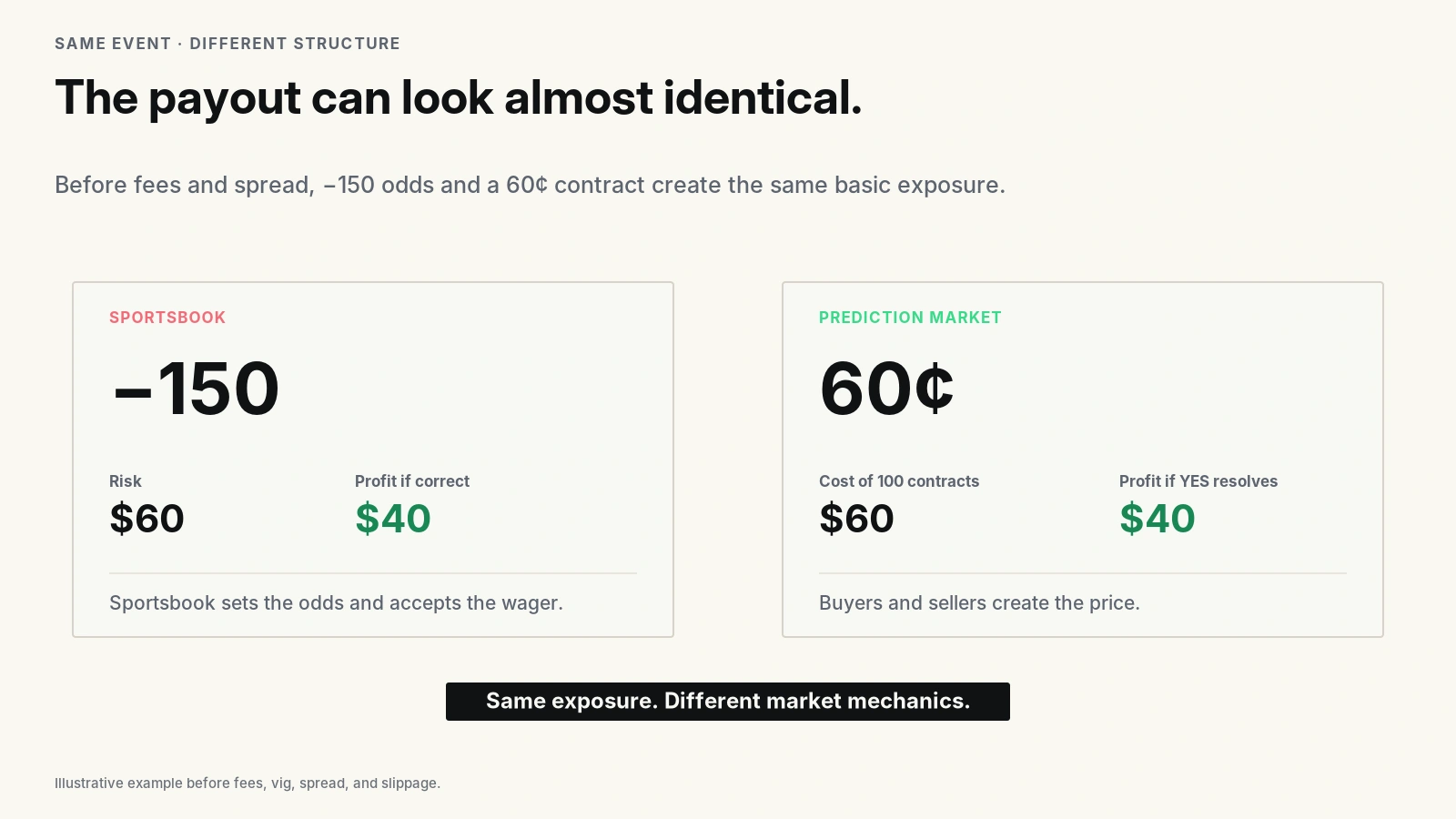
The sportsbook offers Team A at −150.
If you risk $60:
- You make $40 in profit if Team A wins.
- You receive $100 back in total.
- You lose the $60 stake if Team A loses.
In a prediction market
A YES contract on Team A costs 60¢.
If you buy 100 contracts:
- You pay $60.
- The contracts settle at $1 each if Team A wins.
- You receive $100 in total.
- You make $40 in gross profit.
- You lose the $60 purchase cost if Team A loses.
Before fees and execution costs, the exposure is nearly identical.
That is why a prediction market can feel like a sportsbook when both list the same game. But the price arrived there differently, and the rules around your size and exit are not the same.
The biggest difference for serious bettors: who controls your size?
Every market has a capacity limit. A small college prop cannot absorb the same amount as the Super Bowl. The real difference is who decides your personal limit.
At a sportsbook, the operator controls the line and the amount it is willing to accept. Two customers can see the same odds but receive very different maximum wagers.
At a prediction market, the order book is visible to everyone. Your fill depends on how many contracts other participants are willing to buy or sell and at what prices. A profitable trader is not normally given a worse personal order book because the platform believes that trader is sharp.
Sportsbooks can limit a market—and they can limit you
Sportsbooks need risk limits. It would be unreasonable to expect a book to accept an unlimited wager on every obscure prop. But there are two different types of limit:
- A market limit applies broadly because the event is small, early, uncertain, or hard to price.
- An account limit is specific to the customer because the sportsbook sees that customer as higher risk.
A sportsbook may view an account as risky when it repeatedly:
- Beats the closing line
- Bets before the market moves
- Targets soft props or niche leagues
- Takes prices that other sharp books quickly remove
- Wins in categories where the book has weaker information
- Uses promotions in ways that remain profitable
- Shows patterns associated with professional or syndicated betting
The key point is not that every winning ticket causes an immediate limit. Sportsbooks usually care about whether your future action appears likely to be profitable for you and costly for them.
DraftKings' August 2024 Massachusetts house rules reserve the right to lower maximum bets at its discretion, apply pre-imposed limits, accept a requested wager fully or partially, reject it, and restrict account access. That dated example illustrates operator control; current rules depend on operator and jurisdiction. DraftKings House Rules
A widely reported example involved bettor Beau Wagner. After a $1,000 DraftKings bet at 50-to-1 won $50,000, the official DraftKings account promoted the ticket. Wagner told The Washington Post that the next day his NBA maximum was $100 and that a later prop allowed only $3.63. The Washington Post
A widely circulated public example shows a DraftKings slip displaying “Max Wager Limit Reached” with a maximum stake of $134.33, alongside a message attributed to a DraftKings VIP representative saying the trading team changed the customer's limits based on account history and risk exposure. Kosmos has not independently authenticated the exchange shown.
This is standard sportsbook risk management, not an isolated DraftKings policy. The exact limit varies by operator, market, and customer, but major sportsbooks generally reserve the right to decide the maximum stake they will accept. Caesars' house rules, for example, say management determines maximum wagers and can restrict or increase them per customer, sport, or event. Caesars Sportsbook House Rules
The problem for a winning bettor is personalized permission: you can find a great line and still be allowed to bet only a few dollars. The sportsbook controls whether your edge can be scaled.
A real edge is worth very little when you cannot deploy capital
Imagine you find a player prop that you believe has 8% expected value.
- At a $1,000 stake, the estimated expected profit is $80.
- At a $25 limit, the estimated expected profit is $2.
The analysis may still be correct, but the opportunity is no longer meaningful.
This is one reason professional sports bettors use many books, brokers, betting exchanges, and other accounts or counterparties where lawful. They are not only searching for the best line. They are searching for enough capacity to make the line matter.
Exchange limits and order-book depth are different constraints
An order-book exchange matches participants instead of managing a house-banked wager. That changes the incentive to restrict profitable customers, but it does not eliminate eligibility checks, position limits, account controls, or market-integrity rules.
Do not generalize one product’s order-book design to every prediction market. Check the exact venue’s account and contract limits first. Within those limits, the practical question is how much depth exists and what average fill price it supports. Kalshi market-maker and position-limit overview
Your usable size is mainly determined by:
- How many contracts are available
- The prices at which they are available
- How much slippage you are willing to accept
- How much capital you have
In a major market, that number can be massive. A liquid order book can support hundreds of thousands or millions of dollars. For a profitable bettor whose sportsbook maximum has been cut to $100 or less, a prediction market can provide vastly more usable volume.
A sportsbook sets the stake it will accept. An exchange matches orders, subject to its account and contract rules. Within those rules, the public order book determines available size and price.
Large prediction-market positions are possible when liquidity exists
A public Polymarket account view reported by Finbold showed several seven-figure sports positions. The largest visible stake was approximately $3.32 million on one market, with several other positions above $1 million.
This does not prove that prediction-market trading is easy or that a large wager is smart. The same report noted that the account's broader historical performance had been mixed. A million-dollar position can be a million-dollar mistake.
What it does show is the structural difference. The market accepted large positions because other participants were available at the relevant prices. The platform did not need to decide that the customer had “won too much” and reduce the maximum stake to $3.63.
The order book determines executable size
An order must satisfy venue limits and collateral requirements. The order book then determines how much of that permitted size fills at each price.
Suppose a YES contract shows 55¢. The sell side of the order book looks like this:
| Ask price | Contracts available | Cost at that level |
|---|---|---|
| 55¢ | 500 | $275 |
| 56¢ | 2,000 | $1,120 |
| 58¢ | 8,000 | $4,640 |
| 62¢ | 20,000 | $12,400 |
A small trader may buy 100 contracts at 55¢.
A trader trying to buy 25,000 contracts immediately cannot get the full order at 55¢. The order would consume several levels of the book. The average price would be much higher, and the expected value could disappear.
You have three choices:
- Accept the slippage and fill immediately.
- Reduce the size.
- Post a limit order and wait for sellers to come to your price.
That is a market constraint rather than an account penalty. Everyone sees the same available bids and asks.
Large orders can still move the price
Prediction-market traders can face real execution problems:
- A market may have a wide bid-ask spread.
- Only a small amount may be available at the best price.
- A large order can move the market against itself.
- An exit may be difficult if attention disappears.
- A headline price can be a midpoint rather than an executable price.
- A limit order may never fill.
The simple rule is:
You can place an order for any size, but it only fills where counterparties exist. In a major market, that capacity can be enormous.
That is much more trader-friendly than finding an edge and asking a bookmaker for permission to use it.
A sportsbook sets the price. A prediction market discovers it.
How sportsbook pricing works
A sportsbook's trading team publishes odds using:
- Statistical models
- Injury and lineup information
- Prices at sharper sportsbooks
- Expected betting volume
- Customer activity
- Current liability
- A desired margin
The book can move the line, reduce a stake, delay acceptance, send a wager for manual review, or remove the market.
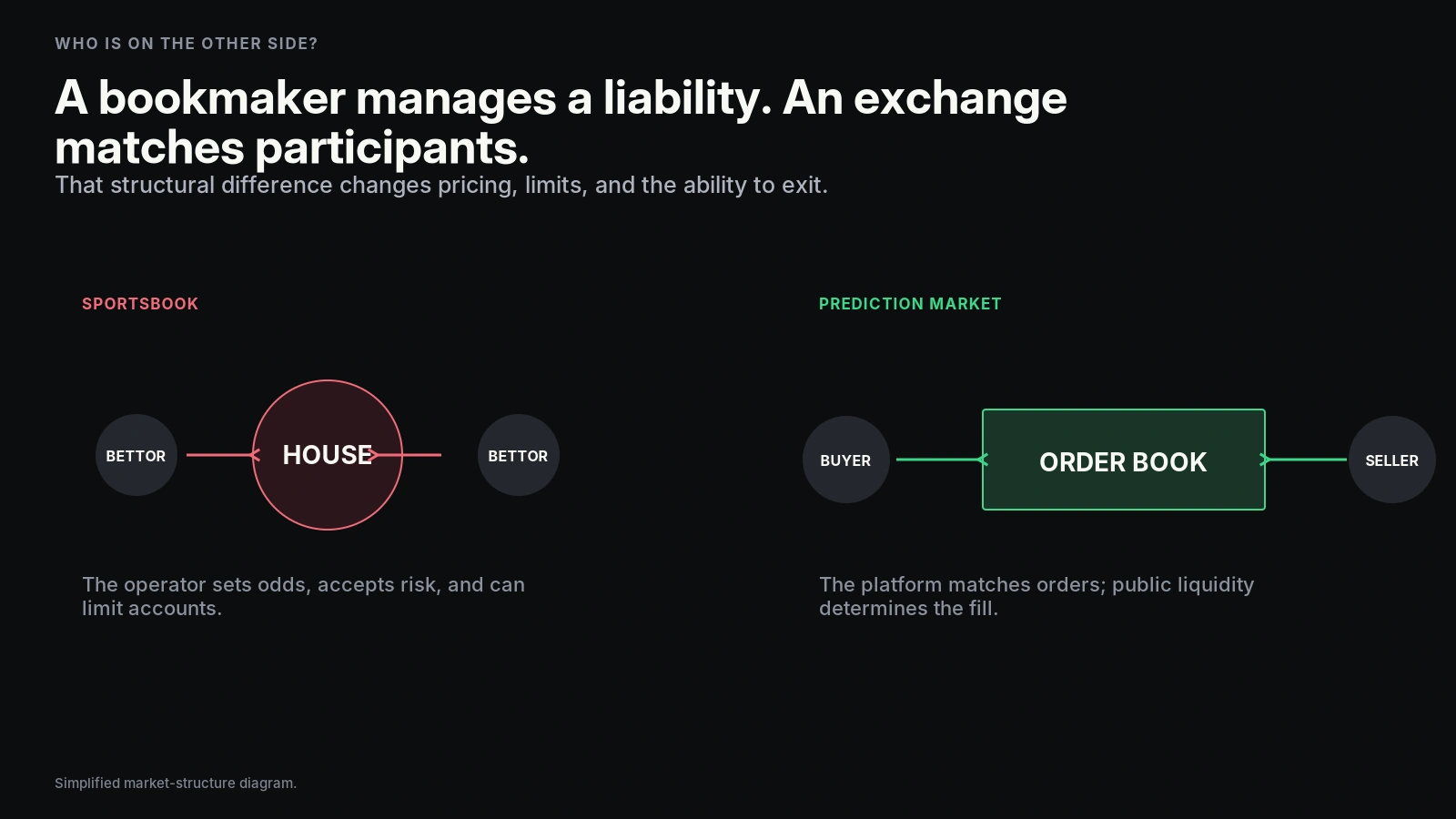
The sportsbook is your counterparty. Your winning ticket is its liability.
How prediction-market pricing works
A prediction market uses bids and asks.
- A bid is the highest price someone will pay.
- An ask is the lowest price someone will sell for.
- The spread is the difference.
- Depth is the amount available at each price.
The exchange matches compatible orders. Market makers and other traders can place orders on either side.
The platform is generally indifferent to whether YES or NO wins. The U.S. Commodity Futures Trading Commission describes regulated prediction-market exchanges as markets that do not take a side of a trade and are not competing against the customer. It also highlights visible customer bids and asks and the ability to trade in or out before settlement. CFTC prediction-market guide
Prediction-market prices are easier to read as probabilities
Prediction-market contracts normally trade from 1¢ to 99¢.
A 65¢ YES contract is roughly a 65% market-implied probability. If it resolves YES, it pays $1. If it resolves NO, it pays $0.
Sportsbooks commonly use American odds:
+150means a $100 stake makes $150 in profit.−150means a $150 stake makes $100 in profit.
| Format | Approximate implied probability |
|---|---|
| 60¢ prediction-market contract | 60% |
| −150 American odds | 60% |
| 1.67 decimal odds | About 60% |
The prediction-market format is easier to reason about because the price is already close to a probability.
But do not confuse the displayed number with the price you can trade. A page may show a 60¢ midpoint while the best ask is 63¢. If you are buying, 63¢ is the relevant number.
Sportsbooks charge vig. Prediction markets charge fees and execution costs.
Neither model is free.
Sportsbook vig
A sportsbook builds a margin into its odds.
A common two-sided market is −110 on both outcomes. Each side implies about 52.38%.
52.38% + 52.38% = 104.76%
The total is above 100%. The extra percentage is the bookmaker's built-in margin before the final distribution of wagers is known.
Prediction-market costs
A prediction-market trade can include:
- An explicit platform fee
- The bid-ask spread
- Slippage across several order-book levels
- The cost of exiting later
- Funding, withdrawal, or network costs where applicable
A “zero-fee” market can still be expensive if the spread is 8¢. A market with an explicit fee can still be cheaper if the spread is tight and depth is strong.
Which one offers the better price?
It depends on the exact market.
Compare:
Sportsbook no-vig probability and payout
with:
Prediction-market executable ask + fees + expected slippage
A prediction market is not automatically cheaper. But it gives you one valuable option that a sportsbook usually does not: you can post your own price with a limit order rather than accepting the number offered to you.
Selling a prediction-market position usually gives better value than a sportsbook cash out
A sportsbook ticket is normally held until settlement. Some books offer cash out, but the sportsbook controls the entire offer:
- Whether cash out is available
- When the button disappears
- What price it offers
- How much extra margin is built into the exit
DraftKings says cash-out availability varies and is not guaranteed. DraftKings Cash Out
Why sportsbook cash outs are usually poor value
A sportsbook cash-out offer is not an open-market sale. It is a private quote from the same company that set the original odds and took the other side of your wager.
That means the book can add another margin when you exit. A 2026 University College Dublin lecture on betting markets states the point directly: bookmakers do not offer fair value on cash outs, and cash-out prices include a margin. Economics of Betting Markets: In-Play Bets and Cash Out
For the same underlying position, a sportsbook cash out is usually materially worse value than selling through a liquid prediction market.
A simple example
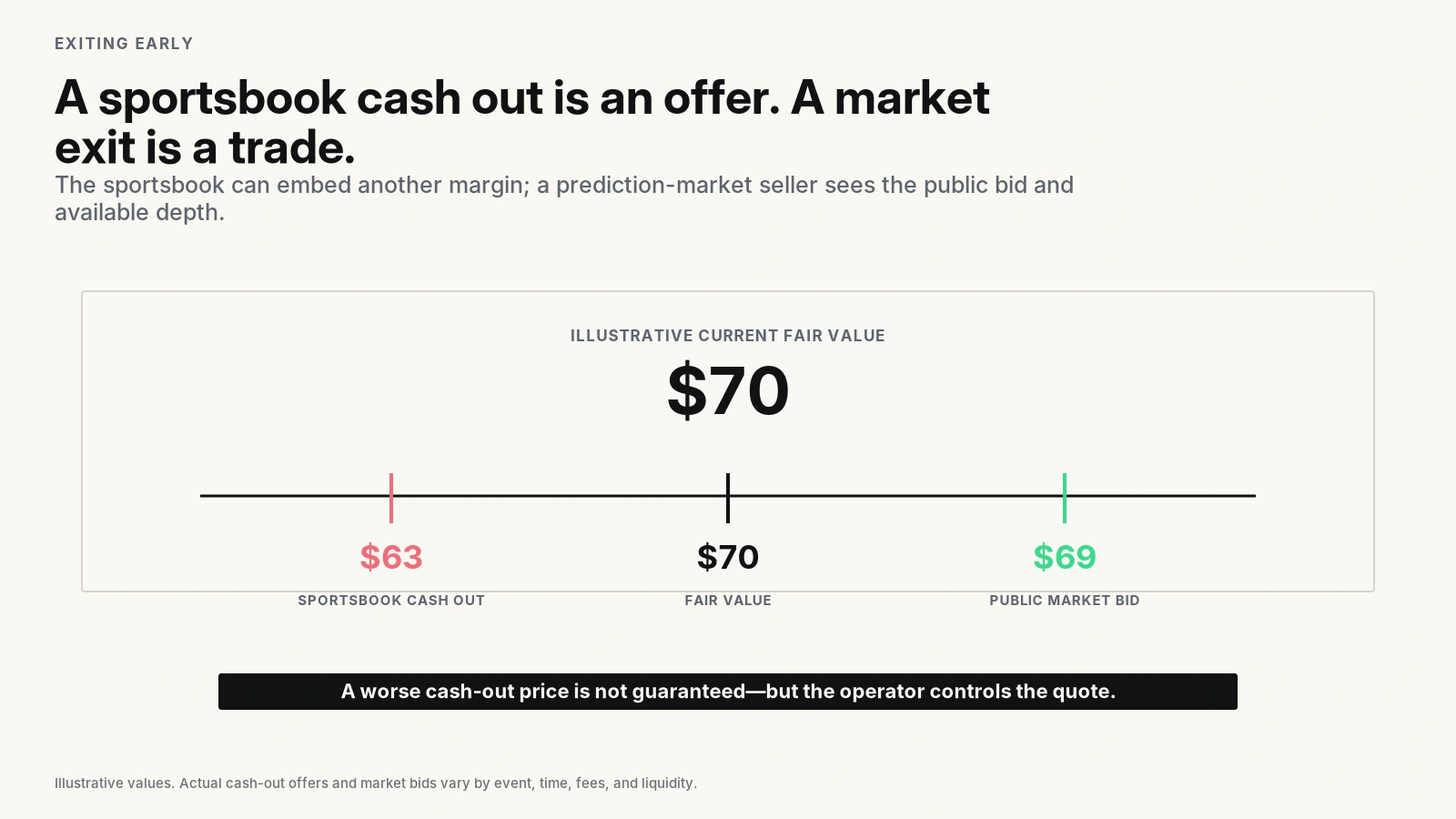
Suppose a ticket pays $100 if it wins, and the current probability of winning is 70%.
A simple fair value for the ticket is about:
70% × $100 = $70
The sportsbook might offer only $63 to cash out. You get certainty, but you give up $7 of current economic value to the house.
Now imagine the same exposure is represented by 100 prediction-market contracts that pay $1 each. If the best public bid is 69¢, you can sell the position for $69 before fees.
The prediction-market exit is not a special offer chosen for your account. It is the best price another participant is publicly willing to pay. In a liquid market, competition between buyers usually keeps that exit much closer to fair value.
Why the prediction-market exit is more flexible
Suppose you buy YES at 40¢. New information arrives and the best bid rises to 65¢. You can sell at the available bid, realize the gain, and leave the position without waiting for the event.
That makes several strategies possible:
- Hold until settlement
- Take profit after a price move
- Cut a loss when the thesis changes
- Trade around news
- Provide liquidity with resting orders
- Reduce exposure as the event approaches
Prediction markets are not magic. If the order book is thin, the best bid may still be poor and a large sale may move the price. But the cost is visible in the spread and depth. On a sportsbook, the cash-out haircut is controlled by the book and may not be offered at all.
Sportsbooks are deeper in sports. Prediction markets are broader across events.
Sportsbooks still have clear advantages for traditional sports bettors.
A major sportsbook may offer hundreds of options for one game:
- Moneylines
- Spreads
- Totals
- Player props
- Alternate lines
- Same-game parlays
- Live micro-markets
- Promotions and odds boosts
Prediction markets increasingly offer sports, but their strongest advantage is breadth.
On prediction markets, you may trade:
- Elections
- Interest-rate decisions
- Inflation data
- Crypto price thresholds
- Company and technology events
- Weather
- Entertainment
- Geopolitics
- Sports results
Kosmos currently organizes markets across venues and categories, including sports, politics, economics, finance, crypto, world events, technology, culture, science, and weather. Its Markets page also shows venue-level volume for Kalshi and Polymarket. Kosmos Markets
A sportsbook is usually better when you want an obscure player prop or a same-game parlay.
A prediction market is usually better when you want to trade probability itself, especially outside sports.
High-volume prediction markets can be extremely sharp
The exchange structure gives traders more freedom, but it does not make profit easy.
High-volume prediction markets attract:
- More market makers
- More professional traders
- More automation
- More cross-venue comparison
- Faster reaction to public news
- Deeper order books that make small edges tradable
That usually makes obvious mispricing harder to capture. It can also create enormous usable capacity: deep markets may support six- or seven-figure positions through the public order book, even when a winning sportsbook account would be capped far lower.
Low-volume markets may offer larger mistakes because fewer people are watching. A new poll, filing, court decision, injury report, or public statement can take longer to affect the price.
But thin markets also have wider spreads, weaker depth, and more uncertainty. The best opportunity is not simply the lowest-volume market. It is a market where you understand the event better than the current participants and can execute enough size without destroying the edge.
Pros and cons of sportsbooks
Sportsbook advantages
- Simple experience: Choose a line, enter a stake, and submit.
- Deep sports coverage: Player props, alternates, parlays, and live markets are hard to match.
- Promotions: Bonus bets and boosts can improve a specific wager's economics when the terms are good.
- Known payout at acceptance: Once a normal fixed-odds wager is accepted, the payout is fixed.
- Good for entertainment: The product is designed around watching sports and placing quick wagers.
Sportsbook disadvantages
- The house controls the price.
- Vig is built into the odds.
- Account-specific limits can make good opportunities impossible to scale.
- A wager can be accepted only partially or rejected.
- Cash-out offers are discretionary and usually include an extra haircut.
- The product is largely limited to sports.
- Promotions and high-margin parlays can encourage worse decisions.
Pros and cons of prediction markets
Prediction-market advantages
- The exchange does not need you to lose. Buyers and sellers take opposing views.
- The same public order book applies to participants in the market.
- Trading capacity depends on venue limits, collateral, and liquidity rather than only a sportsbook’s personalized stake factor.
- You can choose your price with a limit order.
- You can sell at a public market price instead of accepting the book's private cash-out quote.
- Prices are easy to read as probabilities.
- Markets extend far beyond sports.
- Large positions—sometimes millions of dollars—are possible where real depth exists.
- Cross-venue differences can create research and relative-value opportunities.
Prediction-market disadvantages
- Liquidity can be weak. A good headline price may have little size behind it.
- Slippage can erase an edge.
- Contract wording and resolution risk matter.
- A thin market can be moved by one participant.
- The legal and access situation varies by venue and location.
- Market prices can still be wrong. An exchange changes how prices are set; fees, competition, and risk remain.
Which is better: a prediction market or a sportsbook?
For a casual sports fan who wants parlays, player props, and a simple app, a sportsbook may be more convenient.
For a trader who cares about price, control, scalable execution, and the ability to exit, prediction markets are usually the more powerful structure.
That does not mean you should blindly choose the prediction-market price. Sometimes the sportsbook has a better line. Sometimes the prediction market has poor depth. Sometimes the contracts do not settle the same way.
A serious comparison should check:
- Are the two markets asking the exact same question?
- What is the sportsbook's implied probability after removing vig?
- What is the actual prediction-market ask, not only the displayed midpoint?
- What fees apply?
- How much size exists at that price?
- How much will the average fill worsen for your intended order?
- Can you exit later?
- If you need to exit, what bid or cash-out price is actually available?
- Which venue reacts faster to the information you follow?
Our bias is clear: for serious probability trading, the exchange model is better aligned with the trader. It gives you more control, usually offers far more scalable access to a liquid market, and does not need to cut your stake because you have been right too often.
But the best trader still uses whichever venue offers the best all-in price for the exact outcome.
How Kosmos helps you compare prediction markets
The hard part is not opening another app. It is seeing the full market before you trade.
Kosmos brings together several inputs that are normally scattered across different tabs:
- Kalshi and Polymarket markets
- Venue-level prices and volume
- News connected to market impact
- Spread and touch-depth analytics
- Recent movement and reversal
- Market activity and trader performance
- Contract research and source-grounded agents
Kosmos Market Tape can display price, recent movement, spread, touch depth, 24-hour volume, total volume, range, trend strength, and realized variation. Kosmos Market Tape
Kosmos News is organized around news and market impact and includes a “Matched only” view for stories connected to markets. Kosmos News
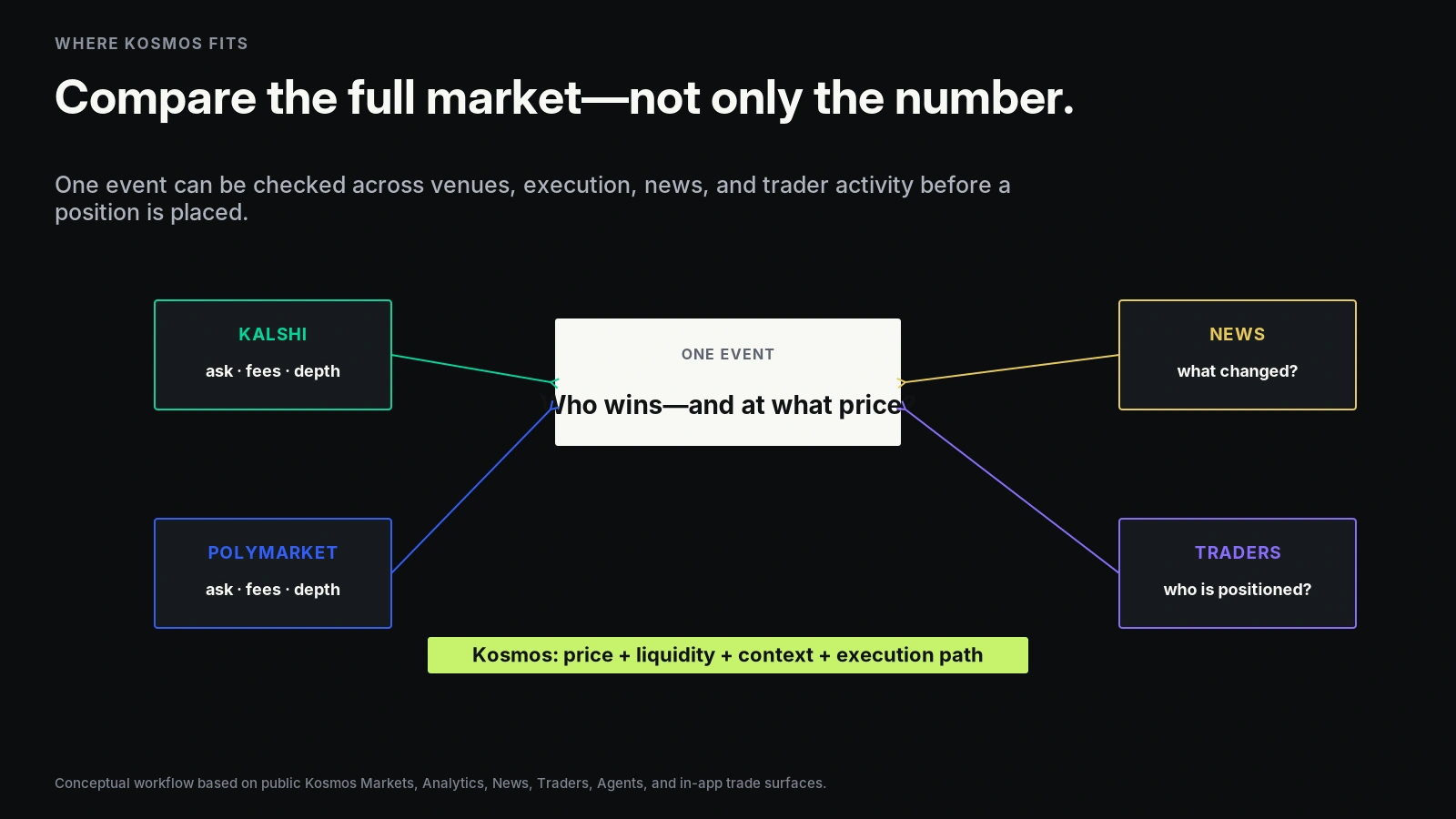
Kosmos does not remove the risk or create liquidity where none exists.
It helps answer the questions a sportsbook bet slip usually hides:
- What is the market's real executable price?
- How much size is available?
- Is the price moving because of news or one large order?
- Does another venue disagree?
- Who is trading the market?
- What exactly does the contract require for settlement?
That is the difference between placing a bet and researching a market.
Key takeaways
Prediction markets and sportsbooks can produce almost identical payouts, but the systems underneath are different.
A sportsbook:
- Sets the odds
- Takes the other side
- Builds in a margin
- Controls account and market limits
- Can accept, reduce, or reject a wager
- Offers the deepest sports menus
A prediction market:
- Matches buyers and sellers
- Lets participants set bids and asks
- Is constrained mainly by the liquidity in the order book
- Does not normally reduce a user's public market access because that user has been profitable
- Lets positions be bought and sold
- Covers a broader range of events
The clearest practical difference is this:
At a sportsbook, you ask the house how much it will let you bet. In a prediction market, you ask the order book how much the market can absorb.
For a serious trader, the second system offers more freedom. But that freedom is valuable only when the contract is clear, the price is good, and enough liquidity exists to trade without giving the edge away.
Sources and methodology
This article uses public operator rules, regulator guidance, platform documentation, reported customer examples, and public Kosmos product pages. Screenshots of third-party platforms are included for editorial explanation and should be reviewed for publication rights before commercial use.
- DraftKings House Rules — betting and payout limitations
- The Washington Post — sportsbook limits and winning customers
- Caesars Sportsbook House Rules — maximum wagers can be set per customer and event
- DraftKings — Cash Out availability and operation
- University College Dublin — cash-out prices and bookmaker margin
- Kalshi market-maker program and position limits
- CFTC — understanding prediction markets and event contracts
- Finbold — source page for the Polymarket position image
- DarkHorseOdds — source page for the DraftKings limit image
- Kosmos Markets
- Kosmos Analytics
- Kosmos News
Frequently asked questions
What is the main difference between prediction markets and sports betting?
A sportsbook sets the odds, takes your wager, and controls your maximum stake. A prediction market matches buyers and sellers in a public order book. The sportsbook is the house; the prediction market is an exchange.
Why do sportsbooks limit winning bettors?
Sportsbooks manage risk as the counterparty to customer wagers. They may lower a customer's limits when the account appears likely to place profitable bets, beat closing prices, target weak markets, or otherwise create expected losses for the operator. A large recent win can attract attention, but the book is usually evaluating future risk rather than simply punishing one successful ticket.
Can a sportsbook refuse my bet?
Yes. Sportsbook house rules commonly reserve the right to set maximum stakes, accept only part of a requested wager, send it for approval, or reject it. The exact rules vary by operator and jurisdiction.
Do prediction markets limit winning traders?
An exchange does not use the same house-banked risk model as a sportsbook. However, account controls, position limits, market-integrity restrictions, available collateral, and order-book liquidity can still limit trading.
Can I trade an unlimited amount on a prediction market?
No. Venue and contract rules, account limits, and available collateral can constrain an order before liquidity is considered. Within those limits, depth determines how much can fill at each price.
Are prediction-market odds better than sportsbook odds?
Sometimes. Compare the sportsbook line after accounting for vig with the prediction market's executable ask, fees, spread, and slippage. The best displayed number is not always the best real trade.
Is selling a prediction-market position better than using a sportsbook cash out?
Usually, yes—when the prediction market is liquid. Sportsbook cash-out offers are set by the book and normally include an additional margin. A prediction-market exit happens at the public bid, so competing traders determine the price. A thin order book can still produce a poor exit, so always check the spread and depth.
Is Kalshi a sportsbook?
Kalshi operates an event-contract exchange rather than a traditional house-banked sportsbook. Participants trade contracts in a market structure. Contract availability and regulatory treatment can change, so users should check current platform rules and local access.
Is Polymarket a sportsbook?
Polymarket uses an order-book prediction-market structure where participants trade outcome shares with one another. It is not structured like a traditional sportsbook that sets odds and takes the customer's wager as the house.
What happens when a prediction market has no liquidity?
An order may not fill, may fill only partially, or may require a much worse price. You can post a limit order and wait, but there is no guarantee another trader will accept it.
Are prediction markets better for large bettors?
Often, yes. A liquid exchange lets large traders access the same public order book instead of receiving a small account-specific maximum based on perceived skill. Large traders still need to watch depth, slippage, and the price available when exiting.
Are prediction markets legal everywhere?
No simple statement covers every venue and jurisdiction. U.S. regulated event-contract exchanges operate under federal commodities oversight, while sportsbooks are generally regulated state by state. Designation alone does not establish eligibility for every person or contract, and access varies. Check the current rules for the platform and location before trading.