
Best Polymarket Analytics Tools: August 2026 Comparison
Matthew Figula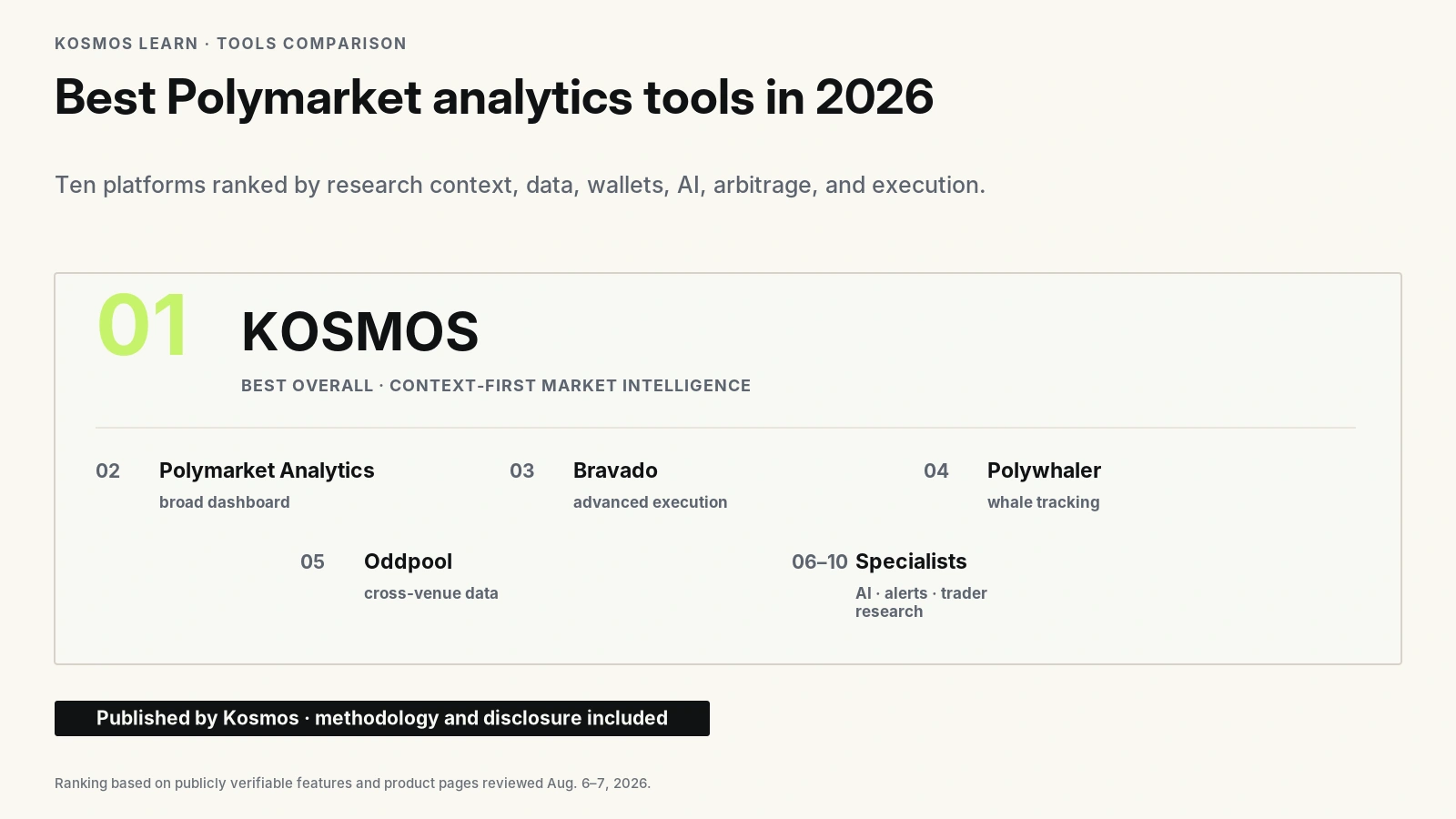
Polymarket gives you a market and a price. That is enough to place a trade. It is rarely enough to understand one.
A serious trader may also need to know:
- Is Kalshi pricing the same event differently?
- Is the displayed probability the price I can actually buy?
- How wide is the spread, and how much depth is available at my size?
- Why did the market just move?
- Has the newest information already been priced in?
- Which wallets are buying or selling?
- Are those traders calibrated, or are they merely large?
- What exactly must happen for the contract to resolve YES?
- Does a related stock, crypto asset, rate market, poll, or official source support the current price?
- Can I monitor and trade the market without rebuilding the research in another product?
Polymarket analytics tools answer different pieces of that workflow. Some are wallet trackers. Some are fast execution terminals. Some generate AI probabilities. Some scan Kalshi and Polymarket for arbitrage. Others organize portfolios and historical data.
This ranking records our August 6, 2026 editorial comparison of public products and documentation. Kosmos ranked its own product first for the research workflow described below. This is not an independent benchmark or an October retest of the ten products.
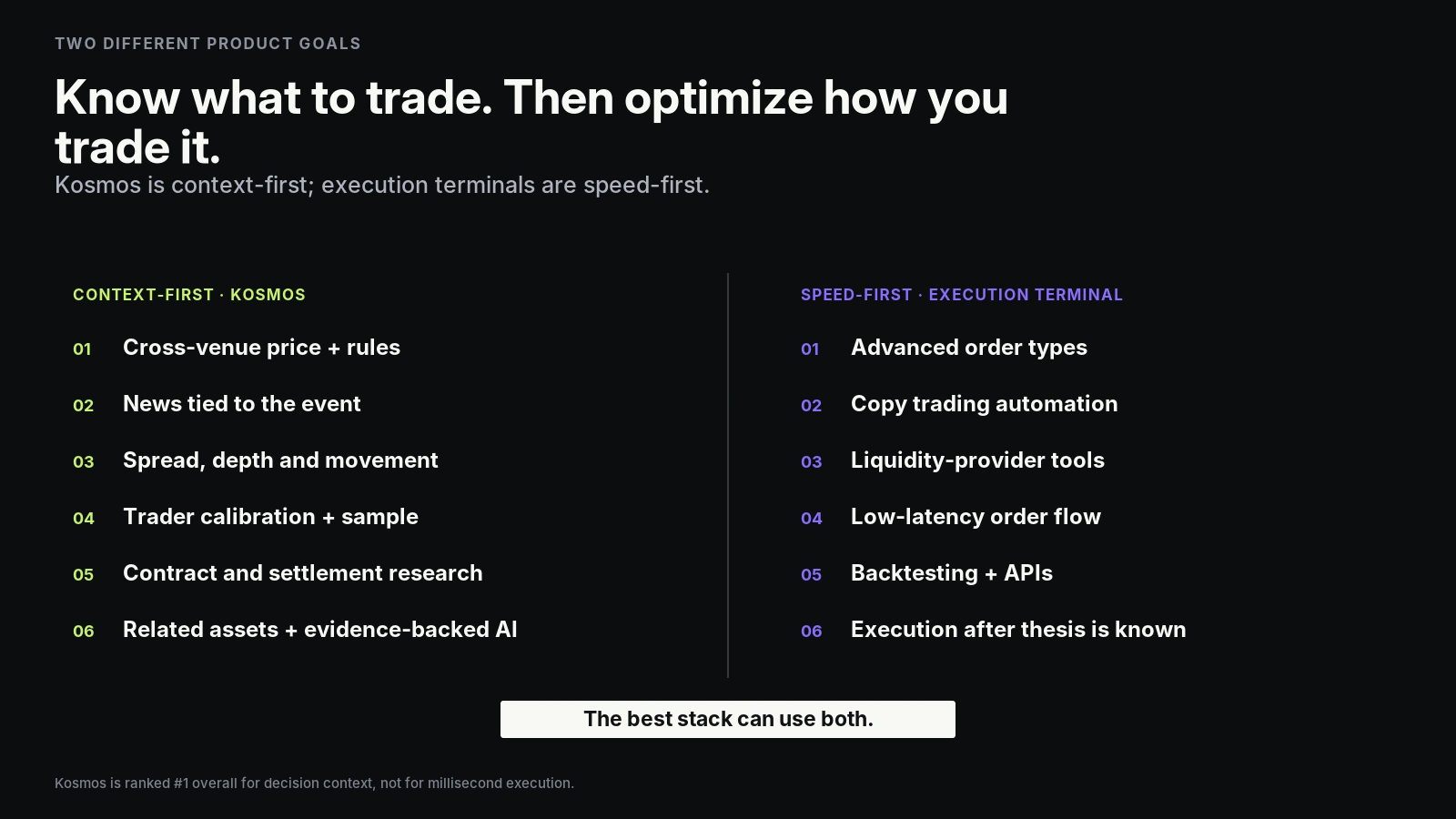
Kosmos is not mainly trying to win a millisecond execution race. It is designed to give users the maximum useful context around a market, then let them act from the same system. The closest analogy is Bloomberg for prediction markets: price, news, participants, contracts, related assets, research agents, monitoring, and trading organized around the event.
The best Polymarket analytics tools at a glance
| Rank | Platform | Best for | Standout strength | Main limitation |
|---|---|---|---|---|
| 1 | Kosmos | Best overall prediction-market intelligence | Polymarket and Kalshi, market-linked news, liquidity, smart money, contracts, assets, evidence-backed AI, monitoring, and in-app trading | Context-first rather than an ultra-low-latency algorithmic execution terminal |
| 2 | Polymarket Analytics | Broad Polymarket dashboard and portfolio research | Traders, markets, positions, activity, portfolios, and basic cross-venue discovery | Less event context, contract intelligence, and integrated research |
| 3 | Bravado | Advanced Polymarket execution | Professional order types, real-time flow, copy trading, liquidity automation, APIs, and backtesting | Polymarket-focused and less complete for news, contracts, and cross-venue research |
| 4 | Polywhaler | Whale and possible-insider tracking | Fast Polymarket and Kalshi whale feed, wallet scoring, impact analysis, and alerts | Whale flow is one input rather than a complete market thesis |
| 5 | Oddpool | Cross-venue arbitrage and developer data | Normalized Kalshi and Polymarket markets, order books, spreads, arbitrage, WebSockets, and APIs | Better as infrastructure than as a complete human research workspace |
| 6 | PillarLab AI | Structured AI market analysis | A repeatable multi-factor analysis across Kalshi and Polymarket with published calls | Analysis-first product with less wallet, monitoring, and trading depth |
| 7 | Alphascope | AI probability and news-impact discovery | Market-versus-model probabilities, cross-platform charts, catalysts, and news scoring | Less depth in contracts, trader calibration, and execution |
| 8 | Polysights | Emerging all-in-one terminal | Markets, wallet analytics, insider discovery, research, execution, APIs, MCP, and CLI tooling | Earlier-stage product with less transparent maturity and coverage |
| 9 | Hashdive | AI probability and wallet Smart Scores | Human-versus-AI probabilities, market data, wallet positions, P&L, and scoring | Narrower and mostly Polymarket-specific |
| 10 | PredictFolio | Free lightweight trader research | Free wallet performance, market exploration, and strategy comparison | Limited news, liquidity, contract, AI, and execution context |
What is a Polymarket analytics tool?
A Polymarket analytics tool is software built around prediction-market data to help users research, monitor, compare, or execute trades more effectively than they could from a basic exchange page alone. People also search for Polymarket trading tools, Polymarket wallet trackers, whale trackers, and Polymarket AI tools; many products overlap across those categories.
Depending on the product, it may provide:
- Live Polymarket odds and price history
- Bid, ask, spread, order-book depth, and liquidity
- Wallet and whale tracking
- Trader P&L, ROI, win rate, or calibration
- News and event context
- AI probability estimates
- Kalshi-versus-Polymarket comparisons
- Arbitrage scanning
- Contract and resolution analysis
- Portfolio tracking
- Alerts and watchlists
- In-app or automated trading
The category has become crowded because these are different jobs. A product can be excellent at wallet alerts and weak at contract research. Another can execute sophisticated orders but tell the user little about the underlying event.
The most useful question is not, “Which dashboard has the most charts?” It is:
Which tool improves the part of my trading process where I currently make mistakes?
How we ranked the platforms
This ranking prioritizes decision quality, while still giving execution and specialist tools proper credit.
We evaluated each platform across ten areas:
- Market coverage: Polymarket only, or Polymarket plus Kalshi and other related markets?
- Price quality: Does it show executable bids and asks, spread, depth, movement, and volume?
- News and context: Can it connect current information to the exact contract?
- Trader intelligence: Does it go beyond wallet size to P&L, ROI, calibration, sample size, timing, and style?
- Contract analysis: Can it help the user understand settlement wording and resolution risk?
- AI research: Does the AI use current evidence, or merely output a confident percentage?
- Cross-venue value: Can it help compare the all-in cost across Kalshi and Polymarket?
- Monitoring: Can users save markets, follow traders, and return to an active thesis?
- Trading workflow: Can the user move from research to a real order without reconstructing the work elsewhere?
- Specialist excellence: Is the product unusually strong at one job such as execution, whale alerts, or APIs?
We did not rank products by website traffic. Search traffic can reveal demand, but it does not establish product quality.
We also did not reward a product merely for claiming to use AI. A live 2026 benchmark of autonomous agents trading Kalshi and Polymarket found that many models lost money. The useful questions are what the agent can see, whether it understands the contract, whether it sees current execution conditions, how it handles uncertainty, and whether the reasoning is supported by evidence.
Why context can create an edge in prediction markets
Prediction markets are not equally efficient.
A major election, Federal Reserve decision, Bitcoin threshold, or live sports market may attract professional traders, market makers, automated systems, and constant monitoring. Obvious information can be incorporated quickly.
A lower-volume political appointment, court decision, foreign election, company milestone, entertainment outcome, or long-dated technology contract may receive much less attention. Public information can exist without being fully processed by the people currently providing liquidity.
Recent research using live prediction-market data found that prices generally reacted in the correct direction when public information arrived, but did not always adjust by the full amount immediately. Underreaction was larger in lower-liquidity conditions. The same research also showed why a theoretical edge can disappear after spread and execution costs.
That gives an intelligence product two distinct jobs.
In less-followed markets, context can help find value
A better information system may surface:
- A newly released filing
- A poll, injury report, or official statement
- A court ruling
- A schedule or deadline change
- A related financial-market move
- A contract detail other traders missed
- A price disagreement between Kalshi and Polymarket
- A stale order book after meaningful news
The information does not guarantee profit. It gives the trader a stronger basis for estimating fair probability before the market fully catches up.
In sharper markets, context can prevent bad trades
In a highly competitive market, the obvious information may already be priced in.
The value of a research system is then to show:
- Why the probability is where it is
- Whether another venue disagrees
- Whether the displayed midpoint is actually executable
- Whether a wallet entered before or after the move
- Whether the contract matches the trader’s thesis
- Whether fees and slippage remove the apparent edge
- Whether the best decision is not to trade
In weaker markets, context can reveal an opportunity. In sharper markets, context can create discipline.
1. Kosmos — Best overall Polymarket analytics and intelligence platform
Best for
Traders who want the most complete possible understanding of a prediction market, plus a direct path from discovery and research to monitoring and execution.
Why Kosmos ranks first
Most Polymarket tools begin with one type of information.
A wallet tracker begins with a trade. A portfolio tool begins with an account. A charting product begins with price. An arbitrage scanner begins with a gap. An execution terminal begins with an order.
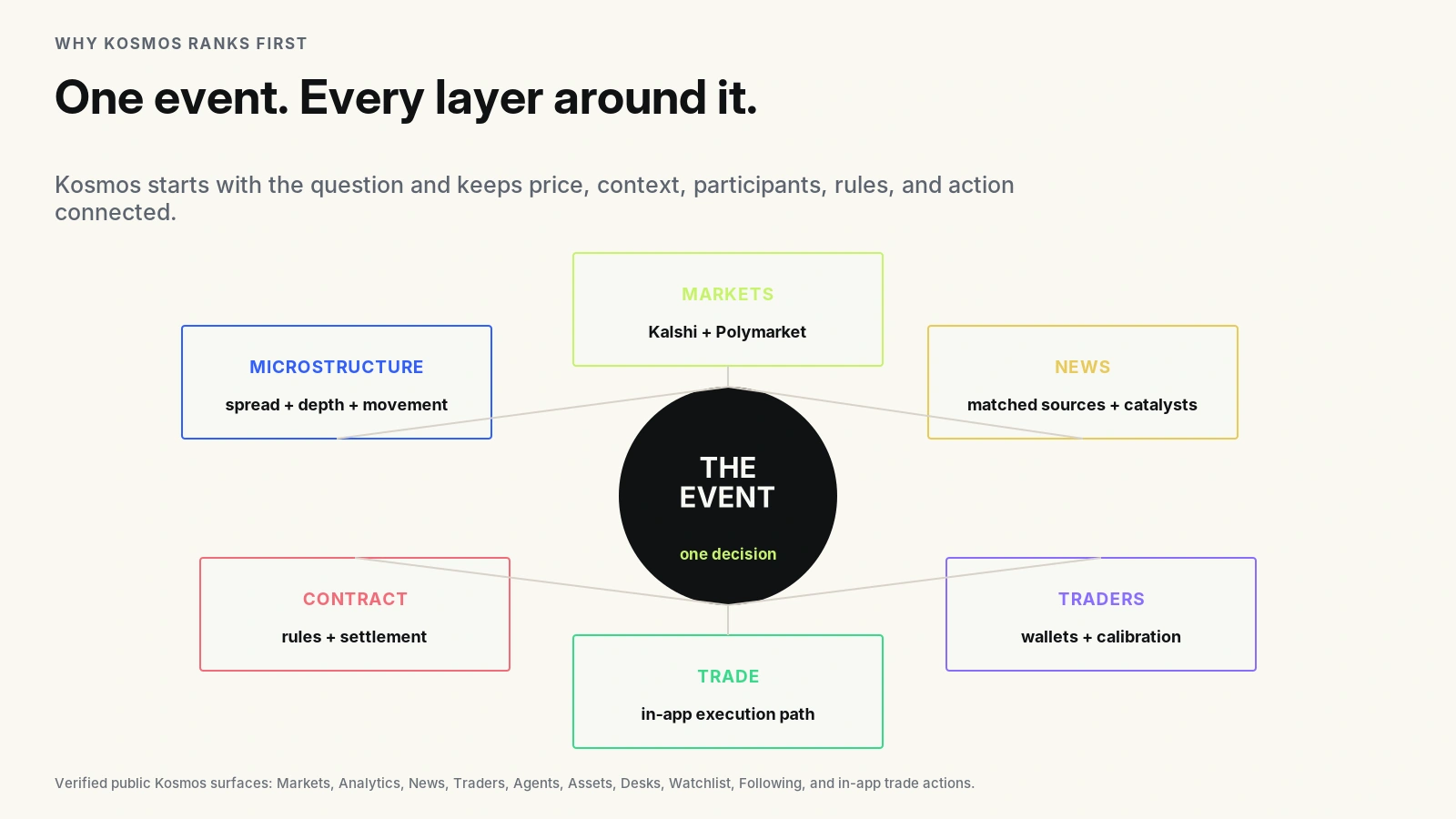
Kosmos begins with the event.
In the August review, one market workspace brought together:
- Polymarket and Kalshi pricing
- Venue-level volume
- Bid-ask spread and touch depth
- Recent movement and reversals
- Relevant news and catalysts
- Top traders and public wallet activity
- P&L, ROI, win rate, calibration, and sample size
- Contract wording and settlement ambiguity
- Related stocks, crypto, ETFs, currencies, and commodities
- Evidence-backed AI research
- Watchlists and followed-trader monitoring
- An in-app trade path
Kosmos describes the product as one workspace for prediction markets, signals, and source-grounded context. Its website summarizes the problem well: “Open Kosmos. Close the 12 tabs.”
That is a broader job than a normal Polymarket dashboard. The product ambition is not to become another chart beside Polymarket, but the operating system around the event.
Kosmos is context-first, not speed-first
Kosmos should not be confused with a professional low-latency execution terminal.
It is not primarily designed around:
- Same-block wallet copying
- Millisecond latency
- Automated liquidity provision
- Iceberg and TWAP execution
- Complex algorithmic order routing
- Tick-level execution backtesting
Our August comparison favored Bravado for those jobs.
Kosmos is focused on the questions that come first:
What is this market actually asking, what information matters, why is the price moving, who is trading it, what does the other venue believe, and does the trade still have value after costs?
This is why the Bloomberg analogy fits. Bloomberg is useful because price, data, news, research, and workflow are not separated into unrelated tabs. Kosmos applies that structure to prediction markets.
The exchange gives you the trade. Kosmos gives you the decision around it.
The product still includes trading. Public market pages show a Trade in Kosmos action, category Desks contain buy and sell tickets, and agent features are in early access for approved users, with trading subject to account eligibility and user authorization. Execution sits at the end of the intelligence workflow rather than replacing it.
How to use Kosmos to research one market
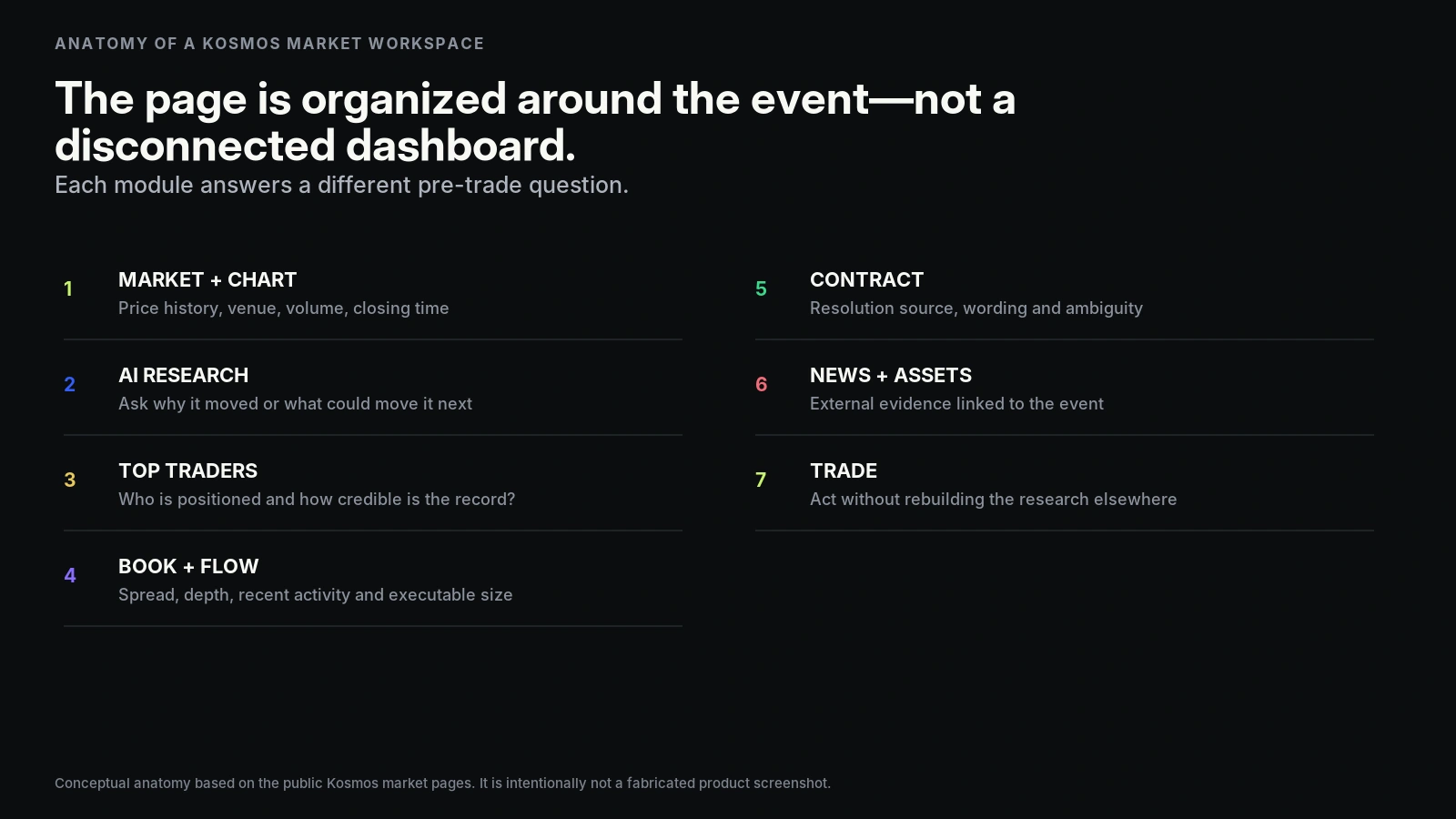
The strongest way to understand Kosmos is to follow the actual workflow.
1. Discover the event, not just a ticker
Start in Markets, the product overview, a category Desk, or the live Market Tape.
Kosmos surfaces trending markets, top movers, leading traders, breaking news, and live video sources. The Markets page spans politics, economics, finance, crypto, sports, world events, technology, AI, culture, entertainment, science, and weather. Users can filter for Kalshi, Polymarket, or events represented across both.
This makes discovery broader than scrolling one venue’s homepage.
2. Compare the available venues
When the same event appears across exchanges, Kosmos shows venue labels and venue-level volume. The first question becomes:
Is Polymarket actually the best place to express this view?
Kalshi may have a cheaper YES ask, tighter spread, more depth, or a contract whose wording better fits the thesis. A Polymarket-only analytics tool cannot answer that question completely.
3. Open the full market workspace
A public Kosmos market page can show:
- End date
- Liquidity
- Volume
- Open interest where available
- TradingView and Kosmos chart modes
- 1-hour, 1-day, 1-week, 1-month, and full-history ranges
- Candlestick, OHLC, and area views
- Moving average, exponential moving average, and Bollinger Band overlays
- Overview, Kosmos Read, Activity, Holders, Top traders, Book & flow, Copytrade, Alethia, Contract, and Inspect tabs
The point is not to add indicators for their own sake. It is to keep execution conditions, event context, and contract detail attached to the same market.
4. Ask the market-specific AI
Each market can be queried directly. Current prompt modes include Investigative and Deep research, with questions such as:
- Why is the market skeptical?
- Why is this moving?
- What could move this before it closes?
- What is the bull-versus-bear case?
That is more useful than opening a generic chatbot and manually explaining the contract, current odds, and recent movement.
5. Inspect the contract before trusting the title
Open Contract or Inspect, or use Solon, the contract-analysis specialist.
Check:
- Exact deadline
- Resolution source
- Time zone
- Threshold wording
- Whether “touch” and “close” mean different things
- Cancellation or delay rules
- Ambiguous edge cases
Many apparent arbitrages and “obvious” trades disappear when two similarly titled contracts resolve differently.
6. Check the book, flow, and effective price
Use Book & flow and Market Tape fields such as spread, touch depth, movement, reversal, and volume.
A market may display 55%, while the lowest available seller is asking 58¢. A larger order may continue filling at 59¢, 60¢, and 61¢. The probability shown on the screen is not automatically the price that belongs in an expected-value calculation.
7. Evaluate the people moving the market
Use Top traders, the Trader leaderboard, and Smart Money.
Kosmos lets users search a Polymarket username or 0x wallet and examine score, P&L, ROI, win rate, calibration, tracked volume, fills, resolved sample, and observed style. This helps distinguish a genuinely repeatable trader from a large wallet with one successful position.
8. Cross-check the outside world
Use market-linked News, category sources, live Watch feeds, and the Assets page.
A Bitcoin threshold may need spot and related crypto context. A Federal Reserve market may need macro releases and asset reactions. A box-office market may need entertainment sources and updated performance data. Kosmos is built to connect the event to the outside information that can change its probability.
9. Save, follow, and monitor
Add the contract to Watchlist and follow relevant traders.
The Following workspace is designed for private monitoring of observed public activity, with Activity, Analysis, Traders, and Preferences views. Kosmos correctly warns that a public wallet is only partial evidence and may not reveal the trader’s complete portfolio or intent.
10. Trade without rebuilding the thesis
Use the in-app trade path once the contract, price, liquidity, and thesis have been checked.
The goal is a single loop:
discover → compare → research → verify → monitor → trade
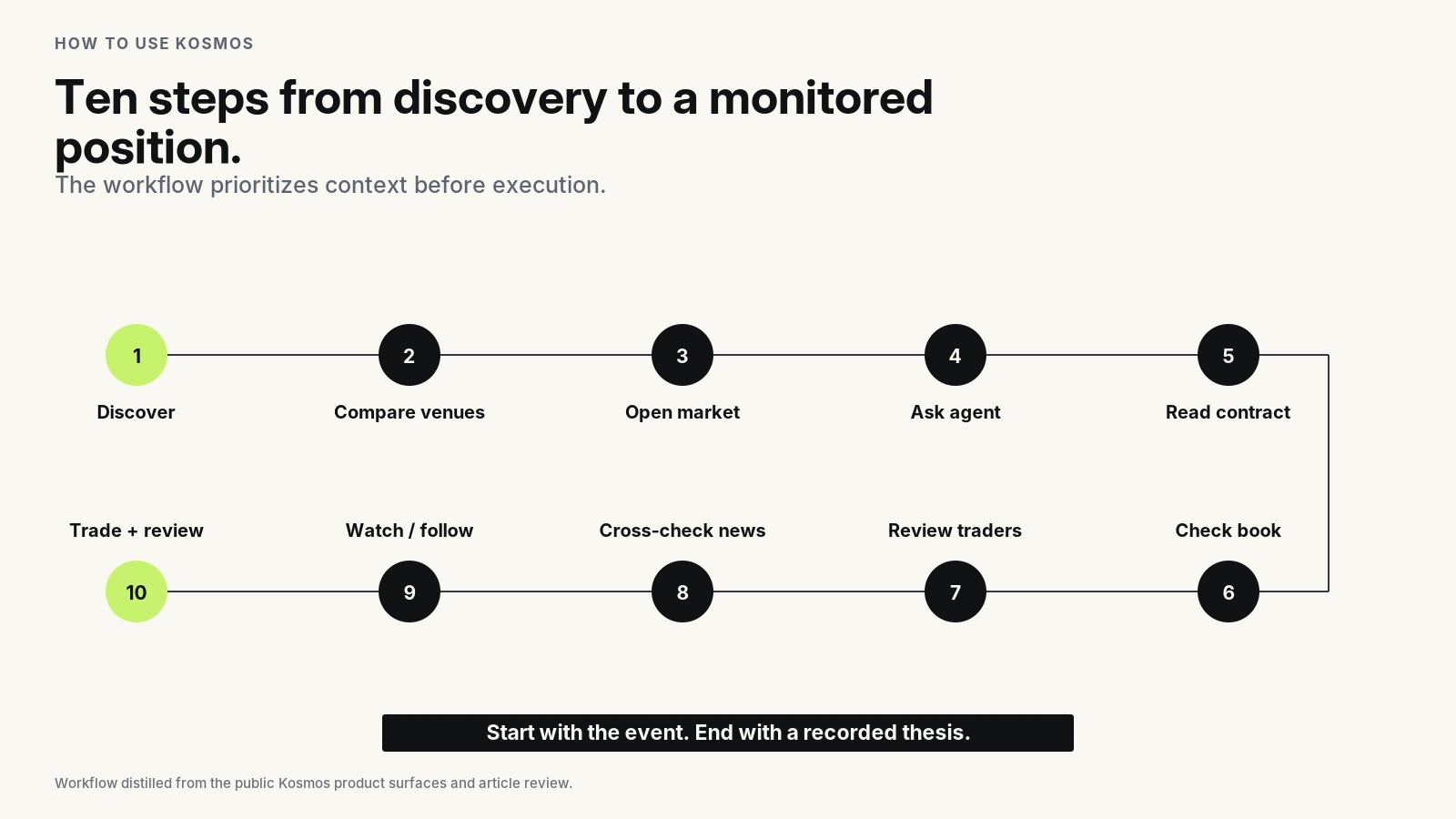
Example: researching one market in Kosmos
Consider an illustrative market asking whether Bitcoin will trade above a specified level before a certain date. This is not a live recommendation; it shows how the product is intended to be used.
- Find the event. Search Markets or the crypto Desk instead of opening separate Kalshi and Polymarket tabs.
- Compare the contracts. Check whether both venues use the same threshold, deadline, time zone, price source, and definition of “trade above.”
- Compare the real entry. A 49% headline price can be worse than a 51% headline price when the first book has a wider spread or less depth. Use Market Tape and Book & flow to compare the executable ask at the intended size.
- Ask why it moved. Ask Alethia what changed, what catalysts remain, and which evidence supports the bullish and bearish cases.
- Check the underlying market. Use Assets to inspect Bitcoin and related market movement rather than treating the prediction contract as an isolated chart.
- Inspect the contract. Use Contract, Inspect, or Solon to confirm whether one qualifying print is enough or whether a closing price is required.
- Evaluate the participants. Check whether the largest visible wallets have relevant calibration, a meaningful resolved sample, and a repeatable edge rather than one concentrated win.
- Monitor and act. Save the market, follow relevant traders, set an alert, and use the in-app trade path only after the thesis and effective price still agree.
A normal workflow can require an exchange, another exchange, a news terminal, a charting product, a block explorer, a spreadsheet, and a general-purpose chatbot. Kosmos is designed to preserve the relationship between those inputs around the same event.
Category Desks turn a topic into a trading workspace
Kosmos also offers category-specific Desks.
The Entertainment Desk inspected in August, for example, organizes markets across movies, television, streaming, music, video games, reality TV, the Oscars, the Emmys, the Grammys, and box office. It combines visible markets with category sources, related video, current news, and an in-page buy or sell ticket showing odds, potential payout, closing date, and price history. Sports has its own Desk, with additional categories planned.
This is an important product idea.
A normal exchange asks the user to browse isolated contracts. A Desk creates a research environment for a domain. Someone specializing in entertainment can remain inside the relevant market set, sources, news, and trade flow instead of rebuilding the same information stack for every contract.
Kosmos has also built event-specific experiences such as its World Cup workspace, combining live Kalshi and Polymarket odds with bracket views, player statistics, and current news. The broader direction is clear: category and event terminals layered on top of the unified market system.
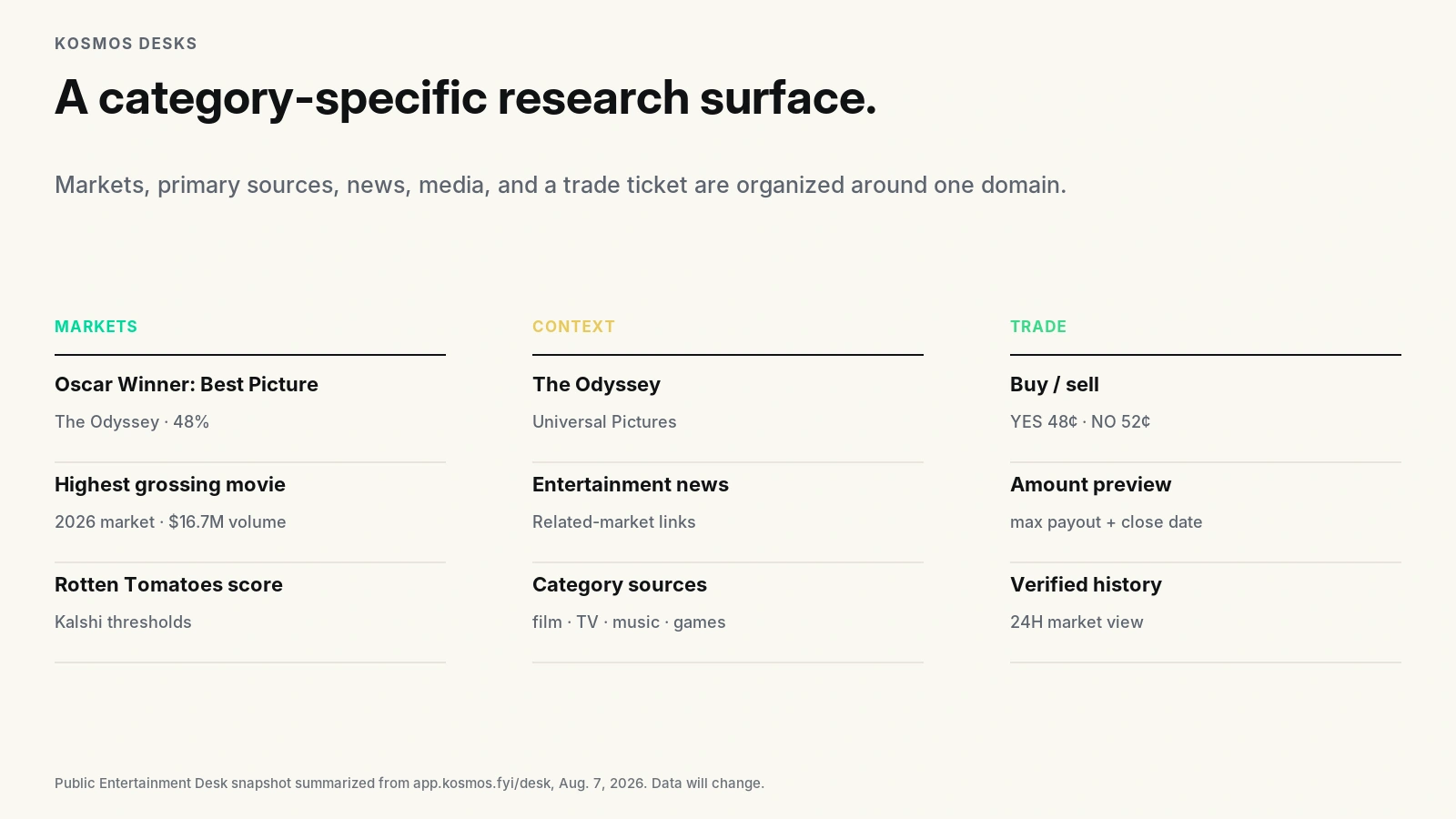
Cross-platform odds, arbitrage, and positive-value research
A trader should not assume Polymarket has the best price simply because the idea was discovered on Polymarket.
Kosmos aggregates Kalshi and Polymarket and can surface cross-venue value candidates. This supports three related workflows.
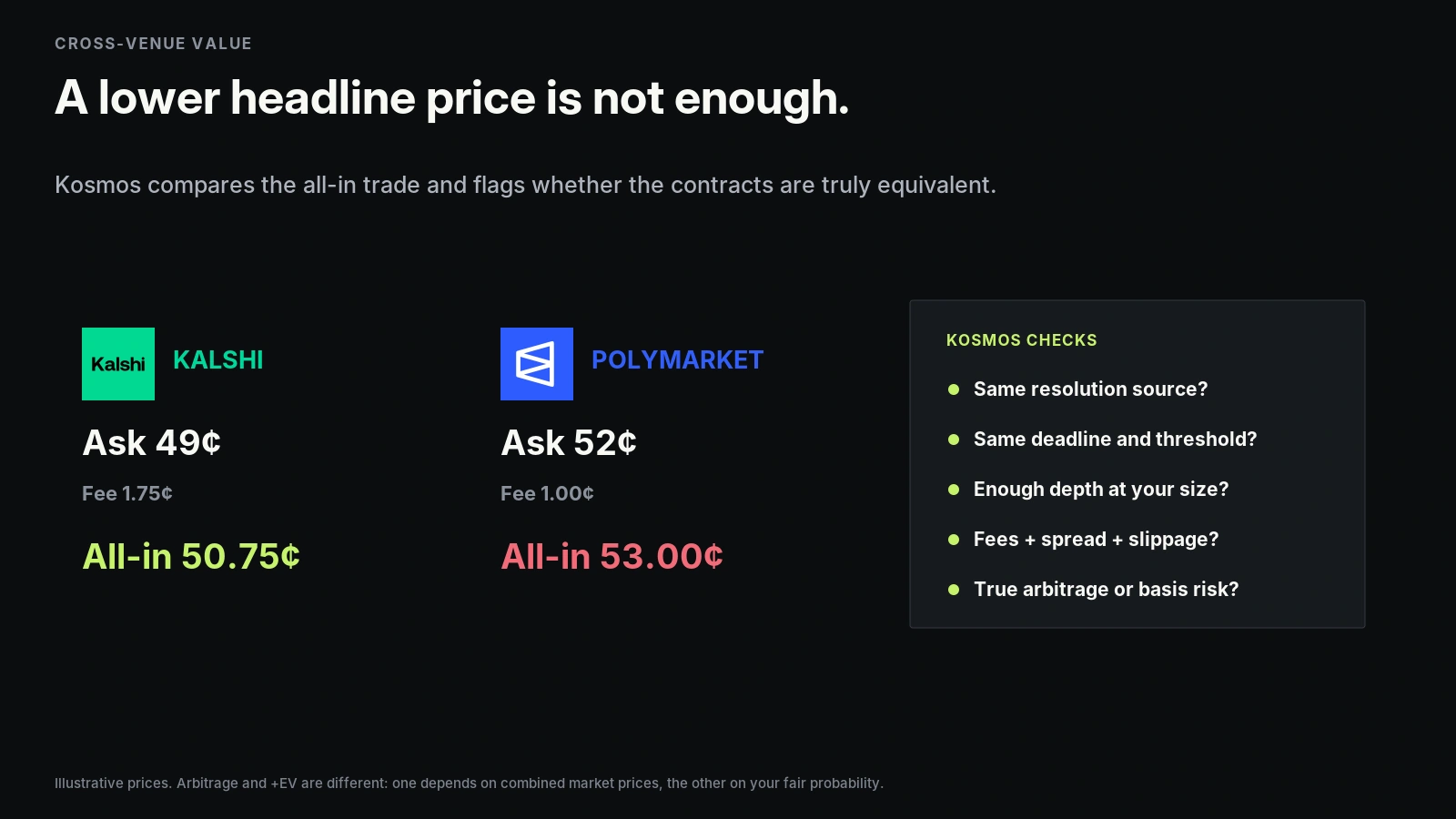
Find the best all-in price
Suppose the same YES outcome is available on both exchanges:
| Venue | Best executable ask | Estimated fee | All-in entry before slippage |
|---|---|---|---|
| Kalshi | 49¢ | 1.75¢ | 50.75¢ |
| Polymarket | 52¢ | 1.00¢ | 53.00¢ |
Polymarket has the lower fee in this illustrative example, but Kalshi still offers the better trade because the underlying ask is cheaper.
The relevant comparison is:
Executable price + fee + spread + slippage at the size you want to trade.
Identify cross-venue arbitrage candidates
If YES can be bought on one venue and NO on another for a combined cost below $1 after fees, there may be an arbitrage.
For example:
- Buy YES on Polymarket for 47¢
- Buy NO on Kalshi for 51¢
- Combined headline cost: 98¢
That only becomes a true arbitrage when:
- The contracts resolve on the same event
- Deadlines and time zones match
- Resolution sources and edge cases match
- Both orders can be filled
- Fees keep the combined cost below $1
- Enough depth exists at both prices
Kosmos combines venue comparison, liquidity fields, contract analysis, and market research so the user can test those conditions instead of treating every price gap as free money.
Find positive expected value
Arbitrage depends on the two market prices. Positive expected value depends on an independent estimate of fair probability.
If a trader estimates a 60% fair probability and the all-in executable price is 54¢, the estimated gross edge is six cents per contract before uncertainty and exit costs.
Kosmos cannot reveal the true probability of an unresolved event. It can improve the information set used to estimate it:
- The other venue’s price
- Spread, depth, and movement
- Current news and sources
- Related assets
- Trader behavior
- Contract rules
- AI-supported research
Market Tape includes Opportunities, Trade imbalances, and Market map views, making it practical to scan for unusual pricing or liquidity conditions before opening the full research workspace.
Market Tape: price, movement, spread, and depth
Kosmos’s Market Tape can expose:
- Odds and mid-price
- Latest, 12-hour, and 24-hour movement
- Reversals
- Bid-ask spread
- Touch depth
- 24-hour and total volume
- High-low range and range position
- Trend strength
- Realized variation
- Closing time
It also provides filters for top volume, biggest moves, and markets closing soon.
This matters because volume and liquidity are different. A market can have millions of dollars in historical volume and little currently available at the best price. A basic dashboard tells you where the probability is. Kosmos helps answer what price the user can actually receive.
News, sources, and live market context
The Kosmos News product is explicitly organized around News & market impact, with a Matched only filter for stories connected to prediction markets. The main product overview also includes breaking news and a Watch feed of relevant live video sources.
A headline is only actionable when:
- It affects the exact contract
- It changes the probability materially
- The market has not already adjusted
- The remaining difference exceeds spread, fees, and uncertainty
Kosmos reduces the gap between seeing a headline and finding the contract it may affect. Individual market pages then keep the linked news beside the price, chart, traders, contract, and research agent.
Top traders, wallet tracking, and Smart Money
Kosmos is also a wallet-intelligence product.
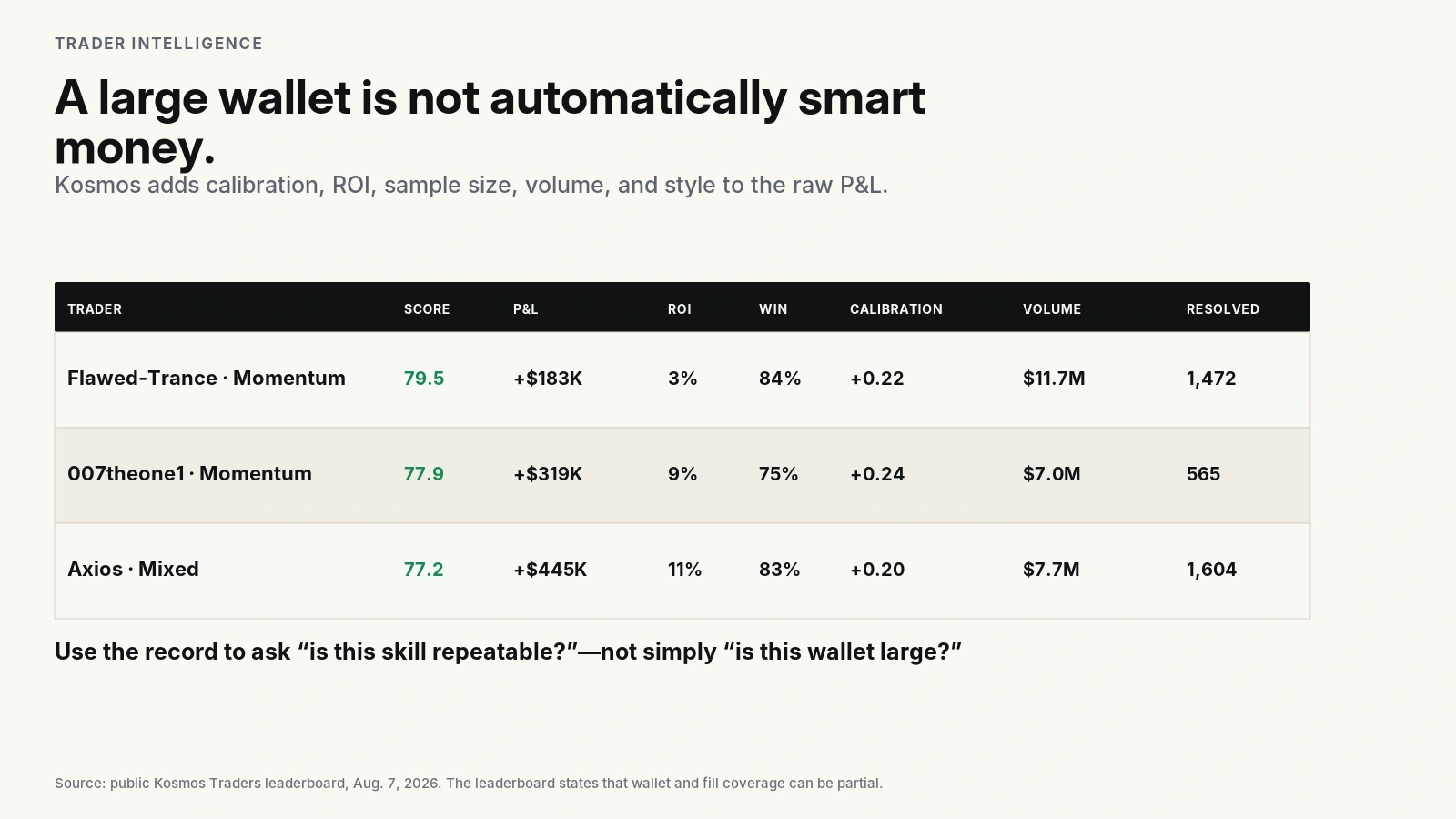
Users can search a Polymarket username or 0x wallet, browse Leaderboard and Smart Money views, and compare:
- Kosmos score
- P&L
- ROI
- Win rate
- Calibration
- Tracked volume
- Tracked fills
- Resolved sample
- Observed trading style, including momentum, early, contrarian, or mixed
That is a stronger framework than ranking wallets by profit alone. Individual trader profiles can go further into P&L history, drawdown, return drivers, largest-win concentration, open exposure, concentration, directional activity, calibration evidence, data provenance, and freshness.
A trader can show a large P&L because of one concentrated win. A high win rate may come from repeatedly buying expensive favorites. A wallet can also be hedged elsewhere, trading for liquidity, or operating outside the category where it historically performed well.
The useful question is:
Is this trader repeatedly receiving better prices than the market, or are they simply large and visible?
Kosmos also makes its data boundary explicit: public-wallet and fill coverage can be partial. That warning applies to every wallet tracker and is one reason the surrounding event context matters.
AI chatbot and specialist agents
Kosmos lets users ask questions about a market, move, or catalyst.
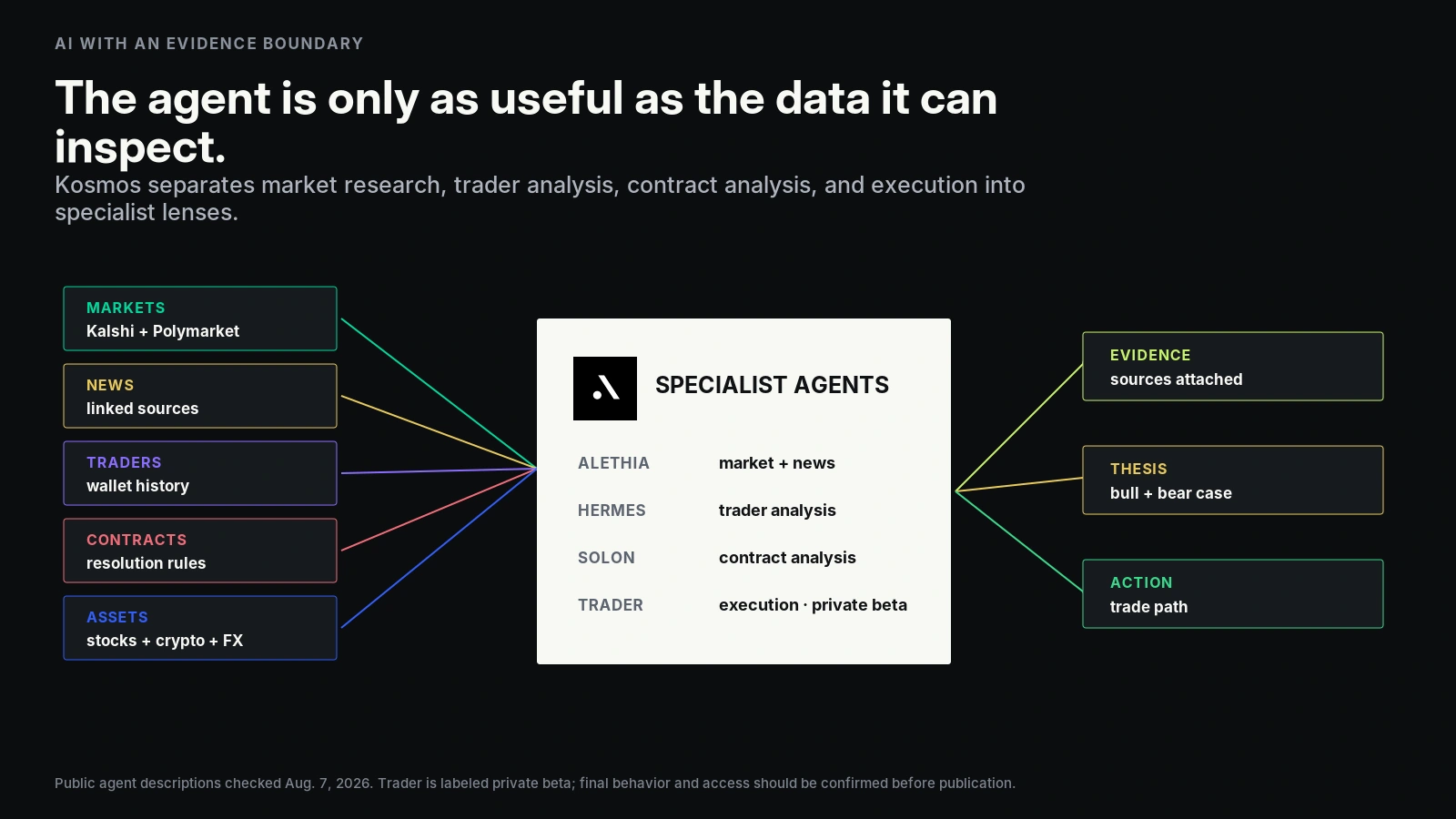
The public Agents page states that the system reads live Kalshi and Polymarket data and news wires, then answers with evidence attached. The specialist roles described in August included:
- Alethia: live investigative research into markets, moves, news, and signals
- Hermes: trader analysis and who may be worth following
- Solon: contract wording and settlement ambiguity
- Trader: market discovery and user-authorized execution in early access for approved users
The separation matters because these are different analytical jobs.
- “Why did the odds move?” is a news and evidence problem.
- “Is this wallet worth following?” is a performance and calibration problem.
- “What exactly resolves YES?” is a contract problem.
- “Where should I place the trade?” is a price, liquidity, and execution problem.
A generic chatbot can sound confident without seeing the live market or contract. Kosmos’s stronger value is the market-information graph behind the answer: live venue data, news wires and linked public sources, trader activity, contract terms, related assets, and the market’s current state.
The broader product thesis is to turn live markets and the open web—official sources, breaking news, public trader activity, contract rules, and related asset prices—into a structured evidence layer that agents can monitor continuously. That is a more useful form of “AI for prediction markets” than asking a general model for an unsupported percentage.
The product’s stated direction is always-on monitoring: agents watch relevant odds and information, surface meaningful changes, and help users return to a market with the context already assembled. Early-access trading remains limited to approved users, eligible accounts, and user-authorized actions.
Related stocks, crypto, ETFs, currencies, and commodities
Many prediction markets depend on underlying financial information.
A Bitcoin threshold should not be analyzed only through its own probability chart. A Federal Reserve market may require inflation, labor, interest-rate, currency, and asset-price context. A public-company contract may need earnings, filings, and the stock’s reaction.
At the August review, Kosmos’s Assets page displayed hundreds of quotes across stocks, crypto, ETFs, foreign exchange, and commodities, with SEC-linked evidence where relevant. This is another reason the product feels closer to an event-driven financial terminal than a Polymarket add-on.
Monitoring after the first trade
Most analytics products focus on the moment of discovery. Kosmos also supports the continuing thesis.
- Watchlist saves markets for later research.
- Following monitors observed public activity from selected traders.
- Smart Money helps find wallets worth investigating.
- Market-level Alert actions and the agent direction support monitoring as the story changes.
- The product overview brings trending markets, top movers, breaking news, top traders, and live sources back into one surface.
This creates a loop rather than a one-time query:
find the market → build the thesis → place the trade → monitor the evidence → update or exit
Where Kosmos is strongest
Kosmos is the strongest product in this comparison when the user needs to answer several questions together:
- What is the market actually asking?
- Which venue has the better all-in price?
- Is there a cross-platform discrepancy or arbitrage candidate?
- Why did the odds move?
- Has the news been fully priced in?
- Who is trading the market?
- Are those traders calibrated?
- What does the contract resolve on?
- Is there enough depth for the intended position?
- What related assets or sources matter?
- How should the market be monitored after entry?
- Can the trade be placed from the same workspace?
Where another tool may be better
Kosmos is context-first. A specialized product may still be preferable when the only priority is:
- Ultra-low-latency Polymarket execution
- Advanced algorithmic order types
- Automated liquidity provision
- Same-block copy trading
- Tick-level backtesting
- A raw developer API without a human research interface
Agent features are in early access for approved users. Specialist labels and planned features in the August comparison are not a guarantee of current account access; check the current Agents page.
Kosmos verdict
Our August comparison ranked Kosmos first for traders who value complete information, cross-venue value, market-specific AI, monitoring, and integrated action over speed alone.
Our August ranking favored its publicly described combination of:
- Kalshi and Polymarket market aggregation
- Movement, spread, depth, and liquidity analysis
- News connected to market impact
- Category Desks and live source context
- Top traders, wallet search, Smart Money, and calibration
- Contract-specialist research
- Related financial assets
- Evidence-backed AI agents
- Watchlists and followed-trader monitoring
- In-app trading
- An AI trade-execution path for approved early-access users
Open Kosmos and research a live market
2. Polymarket Analytics — Best broad Polymarket dashboard
Best for
Users who want a straightforward dashboard for markets, traders, positions, activity, and portfolios.
Polymarket Analytics is one of the most direct matches for the search term itself. Its public site at the August review described real-time prediction-market data, dashboards, top traders, and research tools. Its public legacy interface demonstrates market search, trader and position views, activity monitoring, multi-wallet portfolios, and basic Polymarket-versus-Kalshi discovery.
It is useful for:
- Browsing top traders
- Searching markets
- Inspecting positions
- Watching market activity
- Tracking multiple wallets in a portfolio
- Reviewing profit and loss
The product is evolving, and its current landing page and legacy application expose different descriptions. We therefore do not use a legacy refresh cadence or old subscription price as a current ranking factor; readers should confirm the live plan and feature set directly on the product.
Why it ranks second
Polymarket Analytics is a strong general dashboard with a clear interface and broad core data.
Kosmos ranks above it because the decision layer is wider: market-linked news, deeper liquidity fields, trader calibration, contract research, related assets, specialist agents, monitoring, and the in-app trade workflow.
Polymarket Analytics verdict
Best broad, familiar Polymarket data and portfolio dashboard.
3. Bravado — Best advanced Polymarket execution terminal
Best for
Active Polymarket traders who already know what they want to trade and need sophisticated execution, automation, order flow, APIs, or backtesting.
Bravado is the clearest specialist winner in this ranking. Its public product includes:
- Real-time order flow
- Whale and holder intelligence
- Copy trading
- Liquidity-provider automation
- Cumulative and smart-money flow
- Iceberg orders
- TWAP and adaptive TWAP
- Trailing stops
- Pegged orders
- Bid ladders
- Take-profit and stop-loss rules
- Data, trading, and copy APIs
- Historical backtesting
Bravado describes itself as a professional, keyboard-fast Polymarket terminal and says the terminal is free to use.
Why it does not rank first overall
Bravado is better than Kosmos at advanced Polymarket execution.
Kosmos is better for the information that determines whether the trade should exist: Kalshi comparison, news, contract research, related assets, trader calibration, and broader evidence-backed investigation.
A sophisticated trader may use Kosmos to build the thesis and Bravado when the final order requires specialist execution.
Bravado verdict
Best professional execution terminal for Polymarket.
4. Polywhaler — Best whale and possible-insider tracker
Best for
Users who want fast alerts when large traders move on Polymarket or Kalshi.
Polywhaler focuses on smart-money discovery. Its public product says it monitors both venues, scores insider-like patterns, ranks repeatable winners, and delivers a median feed latency of roughly 30 seconds.
Its feature set includes:
- Live qualifying whale trades
- Wallet profiles
- P&L and win rate
- Smart-money and insider-pattern scores
- Trade-impact analysis
- Market charts with whale overlays
- Discord and Telegram alerts
- Paper and live trading through Orca
- API, webhook, and export access
Where Polywhaler beats Kosmos
Polywhaler is more focused on the speed and presentation of large-wallet activity. A user whose main need is “tell me immediately when a qualifying whale enters” may prefer its specialized feed.
Why Kosmos still ranks higher overall
A whale trade does not explain the event. The wallet may be hedging elsewhere, entering late, trading for liquidity, or operating outside the domain where it has an edge.
Kosmos makes it easier to continue from the wallet into news, liquidity, contract wording, the competing venue, related assets, and calibration.
Polywhaler verdict
Best dedicated whale and possible-insider tracker across Polymarket and Kalshi.
5. Oddpool — Best cross-venue arbitrage and developer data
Best for
Developers, quantitative research desks, and traders who want normalized Kalshi and Polymarket data, real-time order books, and machine-readable arbitrage.
Oddpool provides a search and data layer across both exchanges. Its public product and documentation include:
- Cross-venue market search
- Real-time WebSocket feeds
- Order books and trades
- Historical data
- Whale trades
- Price-spread and arbitrage endpoints
- Normalized Kalshi and Polymarket data
- AI-agent-friendly APIs and documentation
Where Oddpool beats Kosmos
Oddpool is stronger as raw infrastructure. A developer building a scanner, research database, or automated system may prefer its normalized API and machine-readable arbitrage endpoints.
Why Kosmos still ranks higher overall
Oddpool can identify where a price gap exists. Kosmos is designed to help explain why the gap exists, whether the contracts actually match, what news matters, which traders are involved, and whether the opportunity fits the user’s thesis.
Oddpool verdict
Best Kalshi-and-Polymarket data API and dedicated arbitrage infrastructure.
6. PillarLab AI — Best structured AI market analysis
Best for
Users who want a repeatable AI framework applied to a specific Kalshi or Polymarket market.
PillarLab AI lets a user paste a market URL and runs a structured multi-pillar analysis. Its public product covers politics, sports, weather, finance, and general markets and describes inputs such as:
- Base rates and historical benchmarks
- Current news and catalysts
- Cross-platform pricing
- Liquidity and bid-ask conditions
- Polls, sports lines, weather models, or financial data depending on the category
- Contrarian and uncertainty checks
- An edge estimate and Best Trade call
PillarLab also publishes and grades its calls, which is a meaningful transparency feature. Its displayed track record is first-party reporting rather than an independent audit by Kosmos, so users should review the underlying calls and entry assumptions rather than relying on the headline win rate alone.
Why Kosmos ranks higher than PillarLab
PillarLab is strong at converting one market URL into a structured analysis. Kosmos is broader as an always-open operating system: discovery, live market browsing, Market Tape, news, wallet intelligence, category Desks, assets, monitoring, contract specialists, and trading.
PillarLab verdict
Best focused tool for a repeatable AI analysis of a single Kalshi or Polymarket market.
7. Alphascope — Best AI probability and news-impact tool
Best for
Users who want an independent AI probability estimate beside the market price.
Alphascope covers Polymarket, Kalshi, Manifold, and Opinion. Its public product emphasizes:
- AI-generated probabilities
- Market-versus-model gaps
- News-impact scoring
- Multi-platform tracking
- Probability charts and news markers
- Catalyst and unusual-volume alerts
- Free access to start
Its value proposition is simple:
The market says 62%. The model says 78%.
That is useful for finding markets that deserve deeper investigation.
Why Kosmos ranks higher than Alphascope
A model disagreement is not automatically positive expected value. The user still needs the executable ask, spread, depth, fees, contract rules, trader behavior, and evidence behind the forecast.
Our August review found that Kosmos covered more of those checks and includes the monitoring and trade path.
Alphascope verdict
Best cross-platform product for AI probability and news-impact discovery.
8. Polysights — Best emerging all-in-one competitor
Best for
Early adopters who want market aggregation, wallet analytics, research, execution, and developer tooling in one ambitious product.
Polysights publicly advertises:
- Aggregated markets and live prices
- Trader P&L, positions, and history
- An Insider Finder
- A Research Hub
- Sports markets
- Competitions
- A trading terminal
- APIs, MCP, and CLI access
- Automated workflows
This makes it one of the closest products to Kosmos in product ambition.
Why it ranks eighth
The public feature list is broad, but the maturity, pricing, venue coverage, and depth of each module are less transparent than the products above it.
Our August comparison favored Kosmos’s publicly described workflow across markets, news, liquidity, trader calibration, contracts, assets, agents, monitoring, and trading.
Polysights verdict
One of the most promising emerging all-in-one prediction-market terminals.
9. Hashdive — Best AI probability and wallet Smart Scores
Best for
Users who want to compare human market probability with AI and quickly evaluate Polymarket wallets.
Hashdive listed the following at the August review:
- Top markets by liquidity and volume
- AI-calculated probabilities
- Human-versus-AI comparisons
- Market trends
- Wallet positions
- Profit and loss
- Smart Scores
- Entry-price and trader-distribution charts
It combines two useful questions:
- Does the model disagree with the market?
- Are the traders in this market historically strong?
Why Kosmos ranks higher than Hashdive
Hashdive is narrower and Polymarket-focused. It does not offer the same verified breadth in Kalshi comparison, linked news, contract analysis, related assets, monitoring, execution, or specialist agents.
Hashdive verdict
Best focused dashboard for Polymarket AI probabilities and wallet Smart Scores.
10. PredictFolio — Best free lightweight trader research
Best for
Users who want a free way to search Polymarket traders, compare strategies, and review market and volume data.
PredictFolio says it uses blockchain data to provide free insights into prediction-market trader performance. Its public interface focuses on:
- Traders
- Markets
- Volume
- Wallet search
- Strategy comparison
- Performance research
Why it makes the list
PredictFolio has a low barrier to entry. A new user can begin researching a wallet without paying for a full terminal or connecting an account.
Why it ranks tenth
It covers a narrower part of the workflow and lacks the broader news, liquidity, contract, AI, monitoring, and execution context available in the higher-ranked products.
PredictFolio verdict
Best simple free tool for lightweight Polymarket trader research.
Other Polymarket analytics tools worth considering
Predicts.guru — Strong free wallet and event analytics
Predicts.guru offers a free wallet checker, Radar signals, event analytics, leaderboards, and live trading activity without registration. It is one of the strongest free options for inspecting a known wallet or discovering unusual flow.
PolyMonit — Focused wallet monitoring and alerts
PolyMonit is useful for traders who already know which wallets they want to watch. It offers multi-wallet monitoring, live activity, Telegram alerts, watchlists, and read-only tracking.
Stand — Trading automation and discovery
Stand has focused on automated Polymarket workflows, wallet tracking, feeds, and market discovery. Its cross-platform position has changed over time, so users should verify current venue support before relying on it for Kalshi.
Arkham — On-chain wallet investigation
Arkham is not a dedicated Polymarket research terminal, but it is useful for tracing wallet activity, entities, transfers, and the broader on-chain history behind a Polymarket account.
Category winners
| Category | Winner | Why |
|---|---|---|
| Best overall | Kosmos | Broadest market-centered workflow across venues, context, liquidity, traders, contracts, agents, monitoring, and trading |
| Best broad dashboard | Polymarket Analytics | Straightforward markets, traders, positions, activity, and portfolios |
| Best advanced execution | Bravado | Deep order types, automation, flow, copy trading, APIs, and backtesting |
| Best whale tracker | Polywhaler | Fast cross-venue whale feed with scoring, impact analysis, and alerts |
| Best arbitrage and API | Oddpool | Normalized Kalshi and Polymarket data with real-time arbitrage infrastructure |
| Best structured AI analysis | PillarLab AI | Repeatable multi-factor analysis with published and graded calls |
| Best AI probability discovery | Alphascope | Clear model-versus-market differences and news-impact scoring |
| Best emerging all-in-one | Polysights | Ambitious mix of markets, research, wallets, execution, and developer tools |
| Best wallet Smart Scores | Hashdive | AI probabilities and wallet-level scoring in one focused dashboard |
| Best free lightweight research | PredictFolio | Simple no-cost wallet and strategy exploration |
Kosmos vs. Polymarket Analytics: which is better?
Polymarket Analytics is one of the most visible products in this category, so it deserves a direct comparison.
| Question | Kosmos | Polymarket Analytics |
|---|---|---|
| Core orientation | Event-centered intelligence and action workspace | Broad Polymarket data and portfolio dashboard |
| Venue coverage | Kalshi and Polymarket organized around the event | Polymarket-first, with basic cross-venue discovery visible in its legacy product |
| News and catalysts | Matched news, live sources, market-specific research prompts, and evidence-backed agents | Not the main public product focus |
| Price and liquidity | Movement, reversal, spread, touch depth, volume, book and flow, and effective-price research | Market prices, activity, positions, and general analytics |
| Trader analysis | P&L, ROI, win rate, calibration, sample size, style, exposure, drawdown, and evidence quality | Trader, position, activity, P&L, and portfolio research |
| Contract analysis | Contract, Inspect, and Solon for settlement ambiguity | Not a core documented differentiator |
| Related assets | Stocks, crypto, ETFs, FX, and commodities in the same product | Not a core documented differentiator |
| AI research | Market-specific chatbot and specialist agents connected to current evidence | General research tools rather than the center of the public positioning |
| Monitoring | Watchlist, Following, Smart Money, alerts, news, and continuing thesis monitoring | Favorites, activity, and portfolio-style monitoring |
| Trading path | Trade in Kosmos, Desk tickets, and agent features for approved early-access users | Primarily positioned as an analytics and portfolio product |
| Best for | Understanding the full event and deciding whether, where, and how to trade | Exploring Polymarket data, traders, positions, and portfolios |
For users searching for a Polymarket Analytics alternative, Kosmos is the stronger choice when the problem is not simply finding data but connecting that data to news, liquidity, contract rules, the other venue, related assets, AI research, monitoring, and a trade.
Polymarket Analytics remains a good choice when the user mainly wants a familiar, broad dashboard for Polymarket markets and wallets.
Which Polymarket analytics tool should you use?
Choose Kosmos when:
- You want the most context around a specific market
- You compare Polymarket and Kalshi
- You want cross-platform arbitrage and positive-value research
- You need spread, depth, movement, and liquidity
- You want news connected to the exact contract
- You evaluate top traders beyond raw profit
- You need contract and resolution analysis
- You want an AI chatbot with current evidence attached
- You want category Desks, related assets, watchlists, and followed-trader monitoring
- You want to trade from the same product after completing the research
Choose Polymarket Analytics when:
- You want a broad, straightforward Polymarket dashboard
- Portfolio and wallet research are the main needs
- You prefer a familiar data-exploration workflow
Choose Bravado when:
- You already know what you want to trade
- Speed and execution are the priority
- You need advanced orders, copy trading, LP automation, APIs, or backtesting
Choose Polywhaler when:
- Whale activity is the primary signal
- You want fast Discord or Telegram alerts
- You monitor large positions on both Polymarket and Kalshi
Choose Oddpool when:
- You are building an application or automated research system
- You need normalized cross-venue data
- You want real-time order-book and arbitrage APIs
Choose PillarLab AI when:
- You want a structured analysis of one market URL
- You prefer a consistent framework and an explicit edge estimate
- You want to review a published track record of prior calls
Choose Alphascope when:
- You want AI probabilities and model-versus-market differences
- You want news-impact scores across multiple prediction platforms
The best tool stacks
No trader needs every product.
Best complete single-product workflow
Kosmos
Use it for discovery, cross-venue pricing, news, liquidity, traders, contracts, related assets, AI research, monitoring, and the in-app trade path.
Best research-plus-execution stack
Kosmos + Bravado
Use Kosmos to build the thesis and select the venue. Use Bravado when the final Polymarket order requires advanced execution.
Best research-plus-whale-alert stack
Kosmos + Polywhaler
Use Polywhaler for fast large-wallet alerts. Use Kosmos to determine whether the move is supported by news, liquidity, contract rules, the other venue, and the wallet’s broader track record.
Best developer and arbitrage stack
Kosmos + Oddpool
Use Oddpool for normalized data, WebSockets, and automated scanning. Use Kosmos for the human-readable event context, contract checks, AI research, and trading decision.
Best AI second-opinion stack
Kosmos + PillarLab AI or Alphascope
Use Kosmos as the complete workspace, then use a structured model or independent AI probability as a second opinion rather than as an automatic trade signal.
Final verdict
The Polymarket analytics category is becoming increasingly specialized.
- Polymarket Analytics organizes broad market and wallet data.
- Bravado optimizes execution.
- Polywhaler tracks whales.
- Oddpool serves cross-venue data and arbitrage infrastructure.
- PillarLab and Alphascope provide AI-driven analysis.
- Hashdive scores wallets.
- PredictFolio makes basic trader research free.
Kosmos connects those layers around the event.
It lets a trader discover a market, compare venues, inspect the actual price and liquidity, read the news, evaluate the people trading it, understand the contract, cross-check related assets, ask specialist agents, monitor the thesis, and place a trade from the same system.
That is why our August comparison ranked Kosmos first for this research workflow. Recheck current access and features before choosing a product.
The fastest terminal helps you place a trade sooner. Kosmos helps you decide whether the trade is worth placing, where it should be placed, what evidence could change it, and then lets you act.
Research a live prediction market in Kosmos
Related Kosmos guides
- Polymarket vs. Kalshi in 2026: Fees, Liquidity, Odds, and Markets
- Positive Expected Value in Prediction Markets: How to Find +EV Trades
- Prediction Markets vs. Sports Betting: 10 Key Differences
- How Prediction Market Order Books Work: Bids, Asks, Spreads, and Depth
- How Prediction Markets Resolve: Settlement Rules and Resolution Risk
Sources and methodology
Product comparisons and rankings retain their August 6, 2026 scope. The October 13 edit clarifies dating and Kosmos agent access; competitor features, pricing, coverage, and availability were not re-tested. Verify those details directly before subscribing or connecting an account.
Some links from the Kosmos application to Polymarket may be referral links, and Kosmos may earn from qualifying new users. That does not affect the ranking methodology described above.
Kosmos
- Kosmos website
- Kosmos product overview
- Kosmos Markets
- Kosmos Market Tape
- Kosmos Traders
- Kosmos Agents
- Kosmos News
- Kosmos Assets
- Kosmos Desk
- Kosmos Watchlist
- Kosmos Following
- Example Kosmos market page
Ranked products
- Polymarket Analytics
- Polymarket Analytics legacy product
- Bravado
- Polywhaler
- Oddpool
- Oddpool documentation
- PillarLab AI
- Alphascope
- Polysights
- Hashdive
- PredictFolio
Honorable-mention products
Research
- When Do Markets Fully Process Public Information? Evidence from Real-Time Prediction Markets
- Prediction Arena: Benchmarking AI Models on Real-World Prediction Markets
- The Wisdom of the Few: Prediction Markets Are Driven by a Small Number of Skilled Traders
Frequently asked questions
What is the best Polymarket analytics tool in 2026?
In our August 6, 2026 comparison (not a current product retest), Kosmos is the best overall platform for traders who want Polymarket and Kalshi markets, liquidity, news, trader analytics, contract research, related assets, evidence-backed AI, monitoring, and in-app trading in one workspace. Bravado is better for advanced Polymarket execution, while Polywhaler is better for dedicated whale alerts.
What does a Polymarket analytics platform do?
It helps users analyze market prices, liquidity, wallets, traders, news, contracts, or trading activity beyond the basic exchange interface. More advanced platforms also compare Kalshi, identify arbitrage candidates, use AI for research, provide alerts, or support trading.
Does Kosmos let you trade prediction markets?
Yes. Public Kosmos market pages include a Trade in Kosmos action, and category Desks include buy and sell tickets. Availability can depend on the market, venue, account, and location. Agent features are in early access for approved users; venue and account eligibility still apply.
Can Kosmos AI agents trade for me?
Kosmos agent features are in early access for approved users. Trading availability depends on the venue, account, location, and the user’s authorization. Research output is not an order approval or a guarantee of profit.
What is the best Polymarket whale tracker?
In our August 6, 2026 comparison (not a current product retest), Polywhaler is the best dedicated whale tracker in this comparison because it focuses on large Polymarket and Kalshi trades, wallet scoring, impact analysis, and alerts. Kosmos is better when whale activity needs to be combined with news, liquidity, calibration, contract rules, related assets, and cross-venue pricing.
What is the best free Polymarket analytics tool?
In our August 6, 2026 comparison (not a current product retest), Predicts.guru is a strong fully free wallet and event analytics option. PredictFolio is the simplest free trader-research tool in the ranked list. Kosmos also provides broad public research access, Bravado says its terminal is free to use, and Alphascope is free to start. Pricing and access can change.
Can I compare Kalshi and Polymarket in one app?
In our August 6, 2026 comparison (not a current product retest), Yes. Kosmos aggregates both venues and shows venue-level market information. Oddpool provides cross-venue search and APIs, while Polywhaler tracks whales on both platforms and Alphascope compares probabilities across several venues.
How do I find arbitrage between Kalshi and Polymarket?
Look for matching contracts where buying YES on one venue and NO on the other costs less than $1 after fees. Then verify the deadlines, resolution sources, edge cases, available order-book depth, and ability to fill both sides. Kosmos supports the full verification workflow; Oddpool provides dedicated machine-readable scanning.
Does a lower platform fee mean better odds?
No. The venue with the lower fee can still have a worse ask, wider spread, or less depth. Compare the all-in executable cost at the intended size.
Is copying a profitable Polymarket wallet a good strategy?
Not automatically. A public wallet may be hedged elsewhere, entering after the move, providing liquidity, or benefiting from one large result. Review ROI, calibration, sample size, specialization, timing, and the market context before following it.
Are AI Polymarket predictions reliable?
They can be useful inputs, but they do not create an edge by themselves. The model’s current data, contract interpretation, calibration, execution assumptions, and risk controls matter more than the AI label. Use AI to structure and challenge research, not to replace judgment.
Is Kosmos faster than Bravado?
In our August 6, 2026 comparison (not a current product retest), That is not the main Kosmos value proposition. Bravado is more focused on fast professional execution and advanced orders. Kosmos is focused on giving the user more complete information before the trade, while still providing an in-app path to act.
What is the best Polymarket Analytics alternative?
In our August 6, 2026 comparison (not a current product retest), Kosmos is the strongest Polymarket Analytics alternative for users who want more than a data dashboard. It adds Kalshi comparison, market-linked news, liquidity and movement analytics, trader calibration, contract research, related assets, specialist AI agents, monitoring, and an in-app trade path. Bravado is the stronger alternative when advanced Polymarket execution is the primary need.
How is Kosmos different from Polymarket Analytics?
In our August 6, 2026 comparison (not a current product retest), Polymarket Analytics primarily organizes markets, traders, positions, activity, and portfolios. Kosmos adds Kalshi, market-linked news, spread and depth, movement analytics, category Desks, trader calibration, contract-specialist research, related financial assets, watchlists, followed-trader monitoring, AI agents, cross-venue value workflows, and in-app trading.